
AI & ML Security Assessment UAE
Where AI Security Differs from Traditional Security
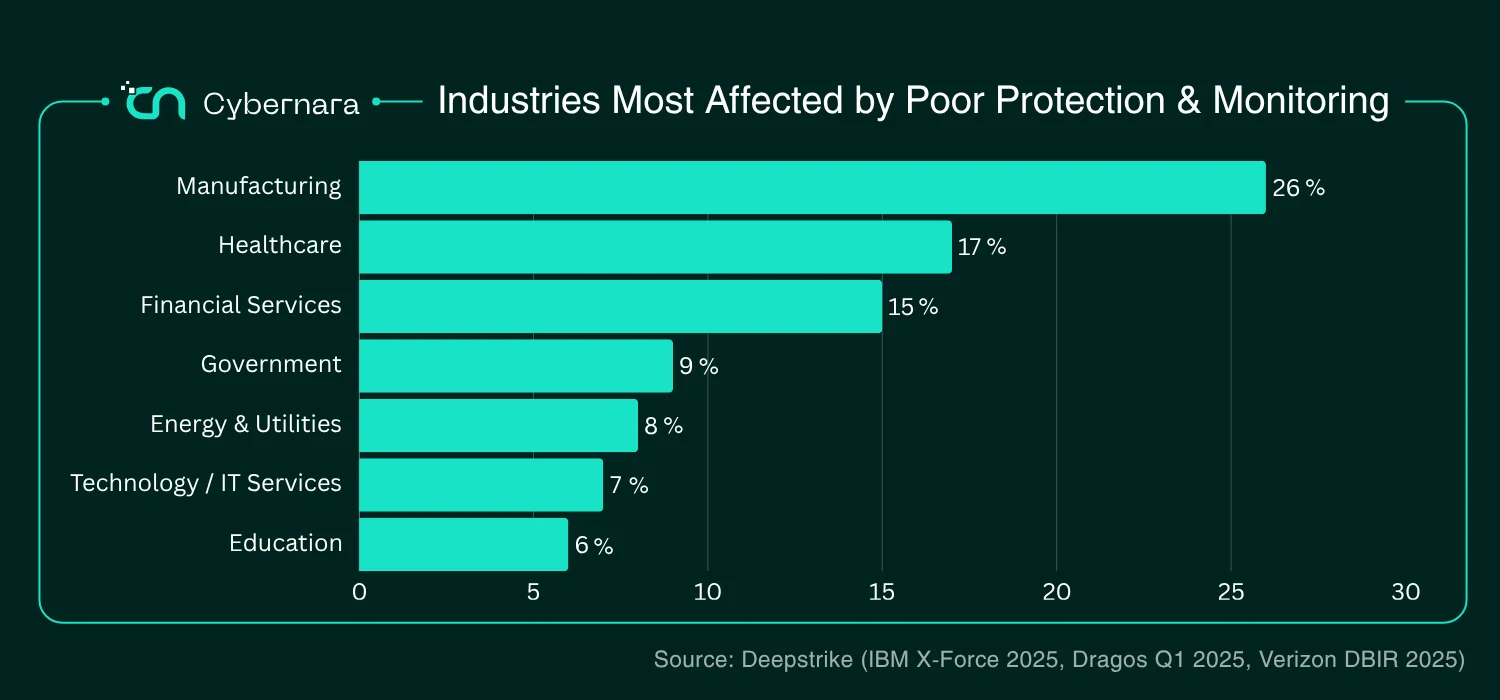
Industries that rely heavily on continuous operations — like manufacturing, healthcare, and finance — remain the most frequent targets of cyberattacks. Weak or delayed monitoring often turns small vulnerabilities into large-scale breaches, as shown below.
Where AI Security Differs from Traditional Security in UAE
Traditional security protects systems, users, and networks. AI security protects something more abstract — the logic that decides what’s true, what’s allowed, and what’s trusted.
Here’s how they differ in practice:
Attack Surface
In traditional systems, attackers target servers, code, or credentials.
In AI systems, they target data, prompts, or the model’s behavior — often without breaching any infrastructure.
Nature of Vulnerabilities
Traditional vulnerabilities are fixed once patched.
AI vulnerabilities evolve — a poisoned dataset or adversarial input can reappear every time the model learns from new data.
Source of Risk
In IT, the risk comes from misconfiguration or weak access control.
In AI, the risk comes from bias, data poisoning, prompt injection, or model inversion — issues that don’t trigger firewalls but can still corrupt decisions.
Visibility and Detection
Security tools can detect malware or anomalies in code, but not subtle manipulations in AI outputs.
An AI model can be compromised silently, with no alert — only wrong predictions or leaked data as signs.
Dependency on External Models
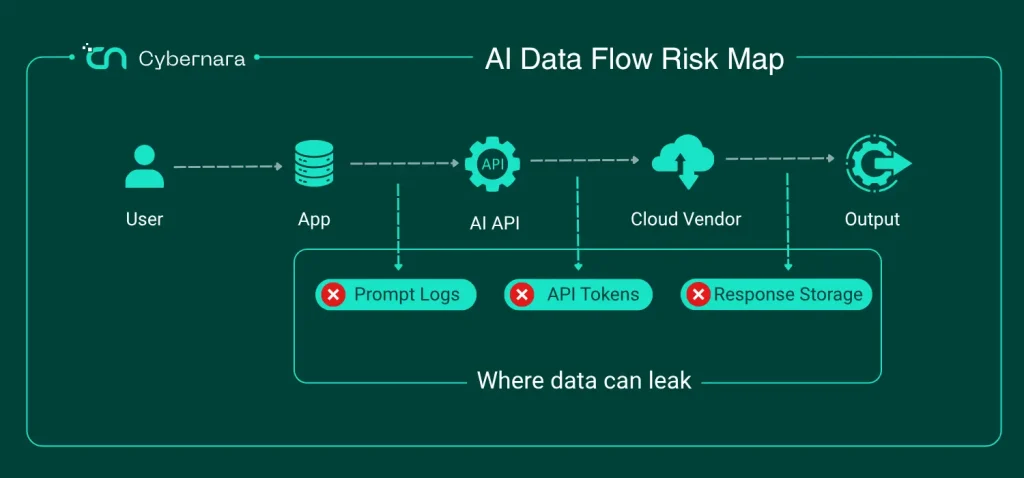
Most organizations don’t host their own AI — they depend on third-party APIs or LLMs.
That means their security extends beyond what they control — into the vendor’s data handling, prompt logging, and retention policies.
AI security isn’t just a new checklist — it’s a shift in how we think about trust, logic, and control inside modern systems.
The Hidden Weak Spots in Everyday AI Usage
Unmonitored AI Integrations
Shadow AI Tools
Prompt and Response Logging
Leaky API Keys
Lack of Vendor Transparency
When monitoring weakens… Threats evolve faster than your ability to respond.
Blind Trust in Model Outputs
Top Causes of Data Breaches in 2025
Clients Who Trust Us







What ML Security Assessment in UAE Includes
Data Pipeline Validation
Model Integrity Testing
Access & Deployment Controls
Runtime Monitoring
Versioning & Update Management
Do You Need Cybernara For ML and AI Security Assessments?
You don’t need an assessment just because AI sounds complex. You need it when AI or ML systems become part of your workflows — handling data, making predictions, or supporting customer operations — and you’re unsure what security controls truly protect them.
These are the signs you might need our help:
AI Integrations Without Oversight
Your teams are using AI tools, plug-ins, or APIs without clear review of where data goes or how it’s stored.
Machine Learning Models Driving Key Decisions
Your models directly influence pricing, fraud detection, or analytics — but haven’t been tested for data poisoning or integrity risks.
No Visibility Into AI Logs or Prompts
You can’t track what’s being entered into AI tools or how responses are handled across your systems.
Shadow AI in the Workplace
Employees use unsanctioned AI apps that might process confidential data outside approved environments.
Upcoming Compliance or Audit Reviews
You’re preparing for ISO 27001, SOC 2, or other frameworks where AI governance now plays a role.
Need for 24/7 Monitoring
You want continuous visibility, anomaly detection, and alerting for AI or ML usage within your infrastructure.
At Cybernara, we don’t just assess configurations — we test how your AI and ML systems behave in real-world conditions.
Our team combines automated scanning with manual validation to uncover hidden risks before attackers do.
The best time to secure your AI isn’t after an incident — it’s before the first query ever runs.
Services Our Clients Trust Us With
Protect Your Data, People & Business From Threat Attacks
Get Started With A Free Security Audit
FAQs
What’s the difference between AI and ML security?
AI security focuses on protecting AI-driven systems and their logic; ML security deals specifically with safeguarding the data, models, and training processes behind machine learning.
Do I need an AI security audit if I use third-party AI tools like ChatGPT or Vertex AI?
Yes. Even if you don’t build models, your prompts, responses, and integrations can still expose sensitive data.
How often should AI and ML assessments be performed?
Ideally once a year or after major AI integrations, retraining cycles, or new model deployments.
Can AI assessments help with compliance?
Absolutely. Many frameworks like ISO 27001, SOC 2, and GDPR now include AI governance and data-handling clauses.