
Zero Trust Security Services
Our Zero Trust Security Services Are global and Available In Multiple Countries
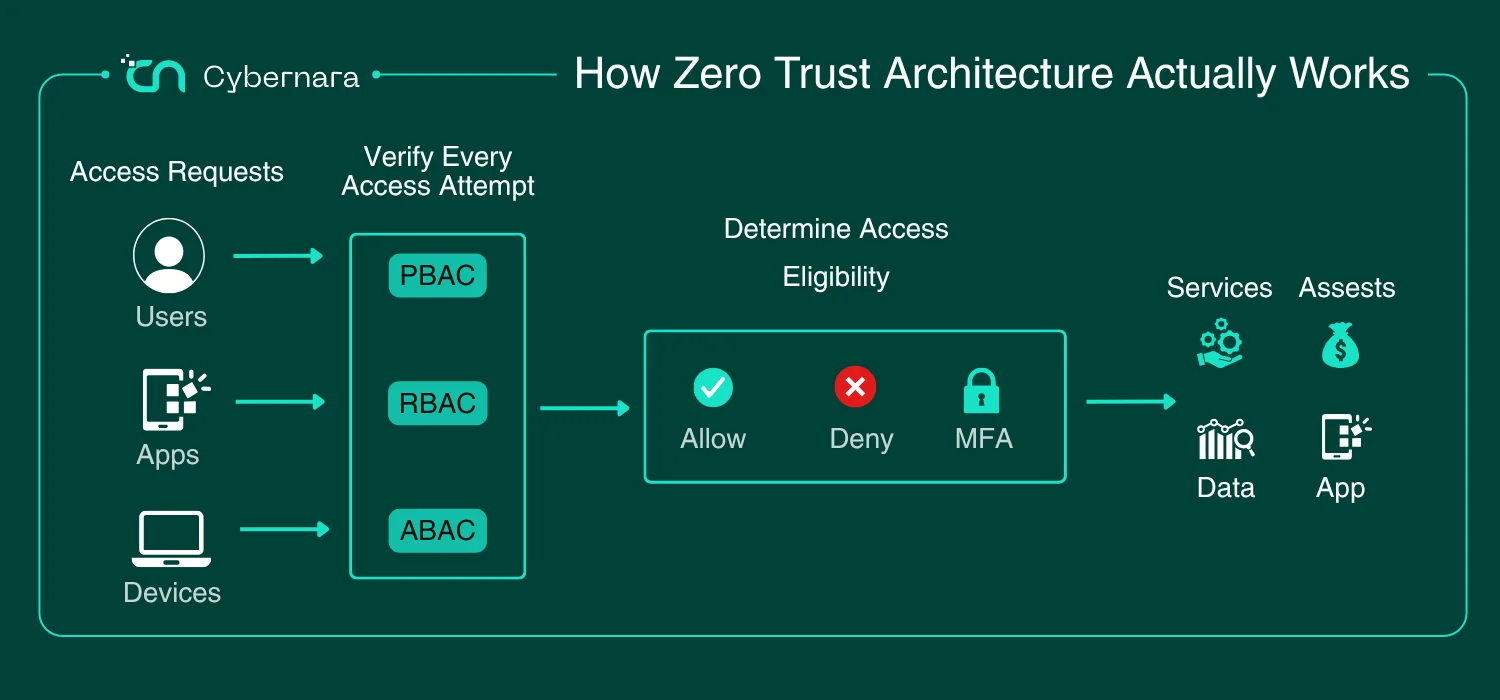
How Zero Trust Architecture Actually Works
Why Zero Trust Was Created
The traditional security model was built for a world with physical perimeters — offices, servers, and internal networks.
Once a user was inside, they were trusted. That worked decades ago. It doesn’t now.
The Modern Enterprise Is Borderless
Today, data lives across clouds, devices, and geographies.
Employees log in from anywhere, contractors access shared systems, and attackers exploit that openness.
The perimeter no longer exists — and trust has become the biggest vulnerability.
Breach Fatigue and Credential Abuse
Most modern cyberattacks don’t start with a “break-in.” They start with a login — stolen passwords, compromised endpoints, or insider misuse.
One trusted credential can unlock an entire organization if unchecked.
Cloud Adoption and Remote Work Changed the Game
Applications, storage, and workflows now live in hybrid environments.
Traditional firewalls and VPNs can’t monitor every connection or enforce consistent policies.
Zero Trust Was Designed for This Reality
It removes the assumption of trust entirely.
Every user, device, and application must prove legitimacy — continuously and contextually.
Access is adaptive, temporary, and restricted to only what’s necessary.
Zero Trust was born because trust became the weakest link. It rebuilds security for a world without borders where verification, not location, defines safety.
Core Principles of Zero Trust
Verify Explicitly
Use Least Privilege Access
Assume Breach
Continuous Monitoring and Analytics
Strong Identity and Device Controls
Zero Trust isn’t a product — it’s an evolving framework of identity, visibility, and control that keeps trust earned, not assumed.
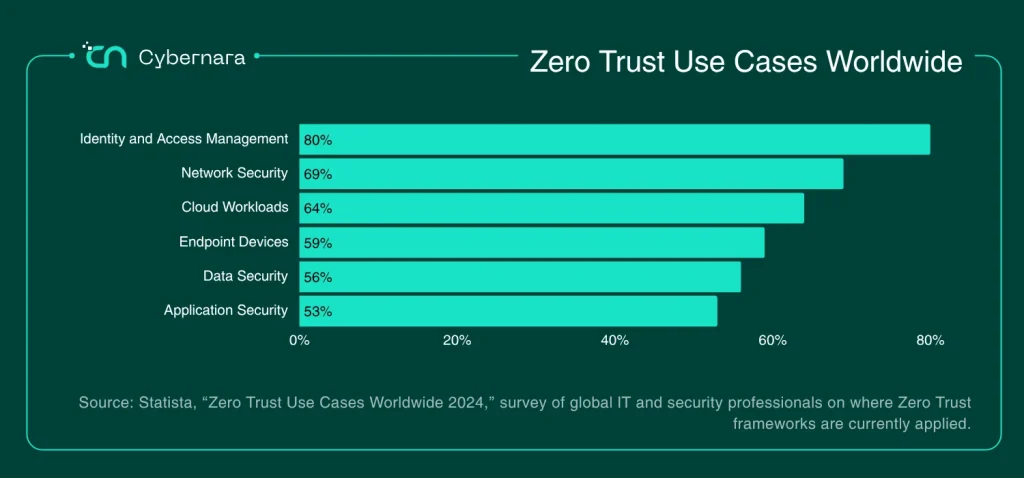
Zero Trust Use Cases Worldwide
Zero Trust isn’t just about user access anymore — it’s expanding across everything an organization runs on. Most companies now use it to secure identities, networks, cloud workloads, and even endpoint devices. It shows that Zero Trust has evolved from a security concept into a complete protection framework for modern IT environments.
Clients Who Trust Us







How Cybernara Implements Zero Trust With Your Existing Systems
Identity and Access Integration
Network Segmentation and Micro-Perimeters
Device Posture and Endpoint Security
Data Protection and Encryption
Continuous Monitoring and Policy Automation
Seamless Cloud and On-Prem Integration
How Zero Trust Strengthens Modern Security Operations
Adopting a Zero Trust model changes security from a one-time implementation into a continuous process of verification and control. Instead of assuming users or systems can be trusted by default, every access request is validated based on identity, device health, context, and behavior.
This approach not only strengthens protection against modern threats but also improves visibility, governance, operational efficiency, and user confidence.
Consistent Security Across Hybrid Environments
Zero Trust applies security policies consistently across on-premise systems, cloud platforms, remote users, and mobile devices. This creates a unified security framework that reduces visibility gaps across distributed environments.
Stronger Defense Against Modern Threats
Continuous verification helps prevent attacks such as credential theft, unauthorized access, lateral movement, and data exfiltration. Access decisions are based on real-time context rather than assumed trust.
Continuous Compliance and Audit Readiness
All authentication attempts, access requests, and policy decisions are logged and monitored continuously. This improves traceability and supports compliance with frameworks such as SOC 2, ISO 27001, GDPR, and NIST 800-207.
Greater Business Agility
Security becomes integrated into operations rather than added as a separate layer later. Teams can adopt cloud services, deploy applications, and onboard users more quickly without compromising security standards.
Lower Operational Risk and Reduced Costs
Centralized policy management and automated access enforcement reduce manual administrative effort and improve response times. This helps minimize downtime, operational overhead, and the financial impact of security incidents.
Improved User Experience and Productivity
Users gain secure access to the resources they need without unnecessary friction. Context-aware authentication and access controls improve security while supporting efficient collaboration and day-to-day productivity.
Zero Trust is more than a security model. It creates a foundation for operating securely across modern environments while maintaining visibility, flexibility, and control over every connection and access request.
Services Our Clients Trust Us With
Our Core Services
IT and Infrastructure Services
Cloud and Platform Services
Security and Compliance Services
Development, Data and AI Services
Protect Your Data, People & Business From Threat Attacks
Get Started With A Free Security Audit
FAQs
Is Zero Trust a product or a framework?
Zero Trust isn’t a single product — it’s a security framework and mindset.
It combines identity verification, access control, encryption, and continuous monitoring into one adaptive defense model that protects every connection, not just the network perimeter.
Does Zero Trust mean no one is trusted at all?
Not exactly. It means trust must be earned and re-verified continuously.
Access is granted dynamically based on identity, device health, and risk level — not by location or assumed privilege.
Will implementing Zero Trust slow down daily operations?
When done correctly, it does the opposite.
Cybernara’s Zero Trust designs use adaptive authentication and automation to make verification seamless — users stay secure without constant friction.
Does Zero Trust work with cloud and hybrid environments?
Absolutely.
Zero Trust was built for the cloud era. It protects workloads across on-prem, hybrid, and multi-cloud setups — ensuring consistent access policies wherever your data lives.