
Remote and Onsite IT Support
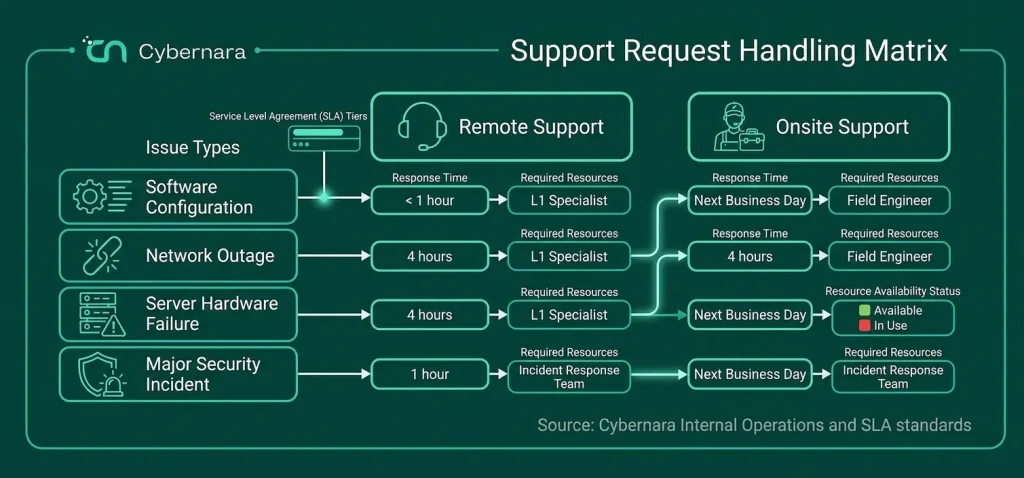
Support Request Handling Matrix
Why Delayed Support Creates Bigger Operational Problems
Support delays don’t stay small they spread across systems, teams, and workflows. What starts as a minor issue quickly turns into a larger operational slowdown.
Work Gets Blocked Across Teams
When one system fails, multiple users are affected. Delays in fixing it slow down entire workflows, not just individual tasks.
Issues Escalate in Complexity Over Time
A small technical issue can grow into a larger problem if left unresolved. The longer it sits, the harder and more time-consuming it becomes to fix.
Deadlines Start Slipping
Delayed support directly impacts project timelines and deliverables. Teams struggle to meet deadlines when systems are unreliable.
User Frustration Builds Quickly
Repeated delays create frustration among employees. This affects morale and reduces trust in IT support.
Temporary Workarounds Create New Risks
Users find quick fixes to continue working, but these often introduce security and operational risks.
Operational Visibility Decreases
When issues are not resolved quickly, tracking what is happening becomes harder. This creates confusion and slows down decision-making.
Why Remote-Only Support Leaves Critical Gaps
Hardware Issues Cannot Be Resolved Remotely
Network and Infrastructure Setup Needs Hands-On Work
Complex Issues Take Longer to Diagnose
User-Side Challenges Remain Unresolved
Delayed Escalation to Onsite Support
Incomplete Resolution of Issues
Clients Who Trust Us







What Breaks When Onsite Support Is Too Slow or Reactive
Extended Downtime for Critical Systems:
Backlogs of Unresolved Issues
Poor Coordination Between Teams
Inefficient Use of Resources
Users Lose Confidence in Support
Why Cybernara Takes an Ownership-Driven Approac
Support breaks down when issues move between teams without clear ownership. Instead of passing problems from one queue to another, we focus on resolving them completely and efficiently.
Clear Ownership From Start to Finish
Every issue is managed with clear accountability from the moment it is reported until it is fully resolved. This reduces confusion and ensures nothing gets overlooked.
Smooth Coordination Between Remote and Onsite Support
When escalation is required, the transition between remote and onsite teams happens seamlessly. This avoids delays and keeps the resolution process moving efficiently.
Resolving the Root Cause
We go beyond temporary fixes by identifying and addressing the underlying cause of issues. This helps prevent the same problems from happening again.
Transparent Communication Throughout the Process
Users stay informed at every stage of the resolution process. Clear updates remove uncertainty and create a more dependable support experience.
Fewer Unnecessary Handoffs
Structured workflows reduce unnecessary back-and-forth between teams. This improves efficiency and helps issues get resolved faster.
Consistent Support Across All Locations
Whether support is delivered remotely or onsite, users receive the same level of service and responsiveness. This creates a reliable and consistent experience across the organization.
Services Our Clients Trust Us With
Our Core Services
IT and Infrastructure Services
Cloud and Platform Services
Security and Compliance Services
Development, Data and AI Services
Protect Your Data, People & Business From Threat Attacks
Get Started With A Free Security Audit
FAQs
How quickly can you respond to issues remotely or onsite?
Remote support can begin almost immediately for most issues. Onsite support is scheduled based on urgency, with faster response for critical problems.
Do you provide both remote and onsite support as part of the same service?
Yes. We combine both approaches so you don’t have to manage separate vendors. Issues are handled remotely when possible and escalated onsite when needed.
What types of issues require onsite support?
Hardware failures, network setup, physical installations, and complex troubleshooting often require onsite presence. We ensure these are handled efficiently without delays.
Can you support multiple locations or distributed teams?
Yes. We support businesses with multiple offices, remote teams, and hybrid setups ensuring consistent support across all locations.