
DevOps and CI/CD Implementation
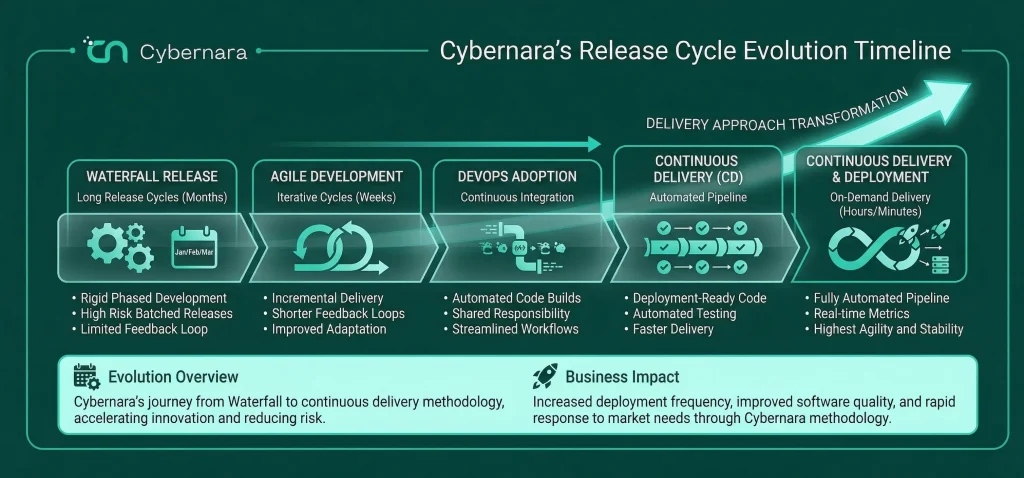
Cybernara's Release Cycle Evolution Timeline
When Deployments Become Slow, Risky, and Unpredictable
Releases don’t usually fail because of one big issue. They become unstable when small inefficiencies, manual steps, and lack of structure build up over time.
Manual Steps Increase Error Rates
Deployments rely on human intervention for configuration, updates, and approvals. Even small mistakes can lead to failed releases or production issues.
No Standard Release Process
Every deployment is handled differently depending on the team or situation. This creates inconsistency and makes outcomes unpredictable.
Long Release Cycles Slow Down Delivery
Without automation, deployments take longer to prepare and execute. This delays feature releases and slows down business momentum.
Rollback Processes Are Unclear
When something breaks, there’s no clear or quick way to revert changes. Recovery becomes slow and stressful.
Limited Visibility Into Deployment Status
Teams lack real-time insight into what’s being deployed and where. Issues are harder to detect and diagnose.
Dependencies Cause Unexpected Failures
Changes in one component affect others unexpectedly. Without proper coordination, deployments fail in unpredictable ways.
How Small Deployment Issues Turn Into Bigger Failures
Minor Errors Propagate Across Environments
Inconsistent Environments Create Bugs
Lack of Automated Testing Increases Risk
Delayed Feedback Slows Issue Resolution
Hotfixes Introduce More Problems
No Clear Ownership of Failures
Clients Who Trust Us







Why Manual Deployment Processes Always Fall Short
Human Dependency Limits Speed
Repetitive Tasks Increase Fatigue
No Consistency Across Deployments
Scaling Becomes Unsustainable
Knowledge Is Not Documented or Shared
How Cybernara Improves Delivery Efficiency and Reliability
A strong delivery pipeline is built through automation, consistency, and well-defined processes. Our approach focuses on creating deployment workflows that are reliable, efficient, and easy to maintain as systems evolve.
Automated Build, Test, and Deployment Workflows
We automate key stages of the delivery process, including builds, testing, and deployments. This reduces manual effort, minimizes human error, and improves consistency across releases.
Consistent and Repeatable Deployments
Every release follows a structured deployment process designed to reduce uncertainty and improve reliability. Standardized workflows help ensure predictable outcomes across environments.
Testing Integrated Into the Pipeline
Automated validation and testing are embedded directly into the delivery pipeline. Issues are identified earlier in the development cycle before they can impact production systems.
Aligned Environments Across Development Stages
Development, staging, and production environments are configured consistently to reduce deployment issues caused by configuration drift or environment differences.
Rollback and Recovery Preparedness
Deployment pipelines are designed with rollback and recovery procedures in place so problems can be addressed quickly while minimizing disruption to operations.
Continuous Optimization and Monitoring
Pipelines are continuously reviewed and optimized to improve speed, reliability, and operational efficiency over time. Monitoring helps identify bottlenecks and supports ongoing improvement.
Services Our Clients Trust Us With
Our Core Services
IT and Infrastructure Services
Cloud and Platform Services
Security and Compliance Services
Development, Data and AI Services
Protect Your Data, People & Business From Threat Attacks
Get Started With A Free Security Audit
FAQs
Do we need to change our existing development process completely?
No. We work with your current workflows and improve them step by step. The goal is to make your process smoother and more reliable not replace everything overnight.
How long does it take to implement CI/CD pipelines?
Yes. Even if you don’t build models, your prompts, responses, and integrations can still expBasic pipelines can be set up within a few weeks. Full optimization, including automation, testing, and monitoring, typically takes 60 to 90 days.ose sensitive data.
Can this work with our existing tools and platforms?
Yes. We integrate with your current tools wherever possible whether it’s GitHub, GitLab, Azure DevOps, or others and improve how they’re used.
Will this reduce deployment risks?
Yes. Automation, testing, and controlled deployments reduce human errors and make releases more predictable and safer.