
Identity and Access Management
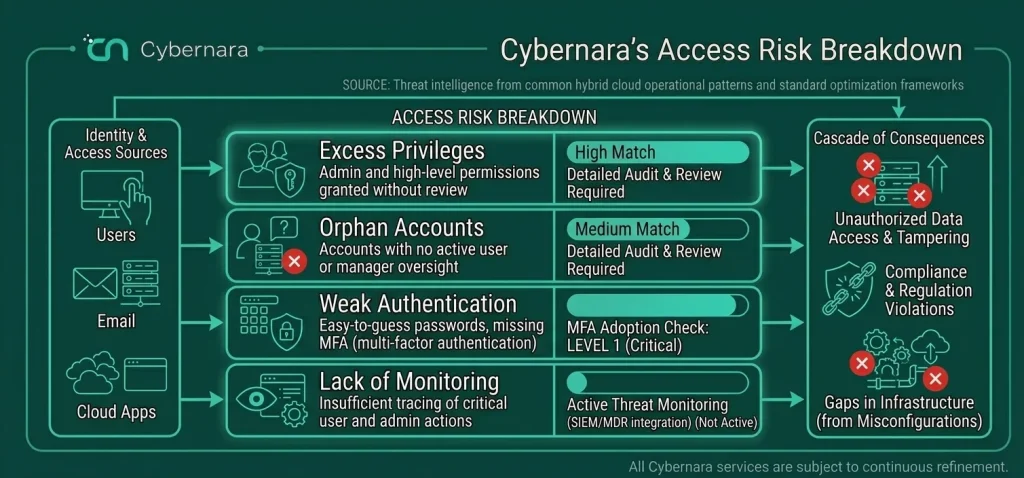
Cybernara's Access Risk Breakdown
Where AI Security Differs from Traditional Security
Access issues don’t usually come from obvious failures. They come from small gaps extra permissions, unused accounts, or access that was never reviewed.
Over-Permissioned Users Across Systems
Users are given more access than they need to do their job. This increases the risk of misuse, whether intentional or accidental.
Unused and Orphaned Accounts
Old accounts remain active even after employees leave or roles change. These accounts become easy targets for attackers.
Lack of Visibility Into Who Has Access
Organizations often don’t have a clear view of access across systems. This makes it difficult to detect risks or enforce control.
Inconsistent Access Policies
Different systems follow different access rules. This creates gaps and makes management more complex.
Delayed Revocation of Access
Access is not removed promptly when roles change. Users retain permissions longer than necessary.
No Tracking of Access Activity
Without proper monitoring, it’s hard to know how access is being used. Suspicious activity can go unnoticed.
The Users, Roles, and Systems Behind Access Control
User Identities Across Systems
Role-Based Access Structures
Authentication and Login Mechanisms
Applications and System Permissions
Privileged Access and Administrative Controls
Access Requests and Approval Workflows
Clients Who Trust Us







How Cybernara Secures and Simplifies Access Management
Centralized Identity and Access Management
Role-Based Access Design and Implementation
Automated Provisioning and Deprovisioning
Continuous Monitoring and Access Reviews
Secure Authentication and Access Controls
How We Combine Operational Control with Usability
Identity and Access Management becomes ineffective when access controls are either too restrictive or too permissive. Our approach focuses on creating the right balance between strong security, operational efficiency, and user experience.
Secure Access Without Disrupting Productivity
Access controls are designed to protect systems and data while allowing users to work efficiently. Security measures support daily operations instead of creating unnecessary obstacles.
Usability Integrated Into Access Design
Authentication flows, permissions, and access processes are structured to be intuitive and easy for users to navigate. This helps reduce user errors, frustration, and ongoing support requests.
Consistent Policies Across All Systems
Access policies and permission structures are applied consistently across cloud platforms, applications, and internal systems. This reduces confusion, improves governance, and minimizes security gaps.
Clear Visibility and Accountability
Organizations maintain visibility into who has access, what resources are being used, and how permissions are assigned. This improves oversight, strengthens accountability, and supports better decision-making.
Simplified and Manageable Access Structures
Access management processes are designed to remain organized and easy to maintain over time. Simplified structures reduce administrative complexity and improve operational efficiency.
Continuous Improvement as Environments Evolve
Identity and access requirements change as organizations grow and systems evolve. We continuously refine access controls, governance models, and user workflows to maintain both security and usability over time.
Identity and Access Management becomes ineffective when access controls are either too restrictive or too permissive. Our approach focuses on creating the right balance between strong security, operational efficiency, and user experience.
Secure Access Without Disrupting Productivity
Access controls are designed to protect systems and data while allowing users to work efficiently. Security measures support daily operations instead of creating unnecessary obstacles.
Usability Integrated Into Access Design
Authentication flows, permissions, and access processes are structured to be intuitive and easy for users to navigate. This helps reduce user errors, frustration, and ongoing support requests.
Consistent Policies Across All Systems
Access policies and permission structures are applied consistently across cloud platforms, applications, and internal systems. This reduces confusion, improves governance, and minimizes security gaps.
Clear Visibility and Accountability
Organizations maintain visibility into who has access, what resources are being used, and how permissions are assigned. This improves oversight, strengthens accountability, and supports better decision-making.
Simplified and Manageable Access Structures
Access management processes are designed to remain organized and easy to maintain over time. Simplified structures reduce administrative complexity and improve operational efficiency.
Continuous Improvement as Environments Evolve
Identity and access requirements change as organizations grow and systems evolve. We continuously refine access controls, governance models, and user workflows to maintain both security and usability over time.
Services Our Clients Trust Us With
Our Core Services
IT and Infrastructure Services
Cloud and Platform Services
Security and Compliance Services
Development, Data and AI Services
Protect Your Data, People & Business From Threat Attacks
Get Started With A Free Security Audit
FAQs
What does identity and access management include?
It includes user authentication, role-based access control, privilege management, and monitoring of who has access to what across systems.
How long does it take to implement IAM?
Initial access controls and visibility can be set up within a few weeks. Full structuring and optimization typically take 60 to 90 days.
Will this reduce security risks?
Yes. Proper access control reduces the risk of unauthorized access, insider threats, and misuse of privileges.
Is IAM only for large organizations?
No. Businesses of all sizes benefit smaller teams gain control, while larger organizations gain consistency and scalability.