
Hosting and Hybrid Infrastructure
Cybernara's Workload Placement Matrix
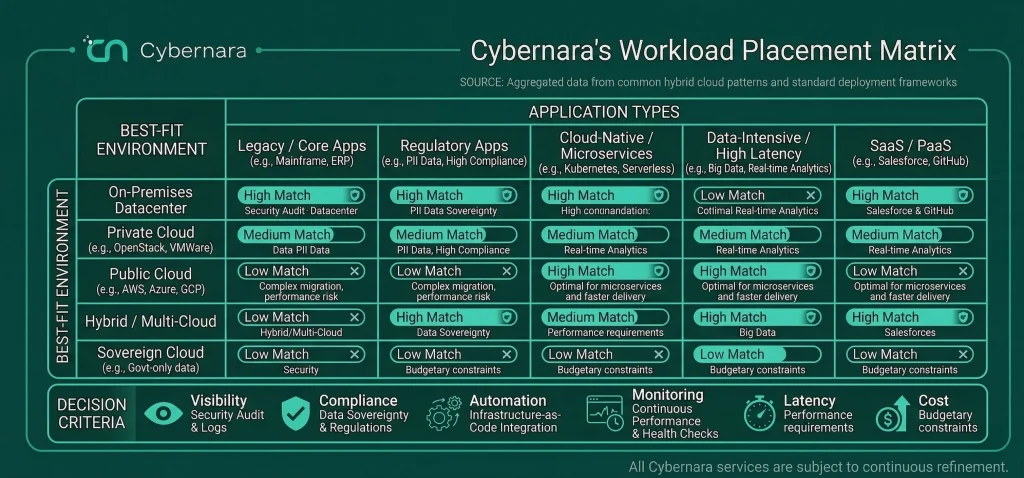
How Fragmented Infrastructure Slows Down Your Business
Infrastructure rarely fails all at once. It becomes a problem when systems are spread across environments without clear structure or coordination.
Systems Don’t Communicate Efficiently
Applications and services across cloud and on-prem environments struggle to connect smoothly. This leads to delays, sync issues, and inconsistent performance.
Data Becomes Hard to Access and Manage
Data is stored across multiple locations without clear organization. Access becomes slower, and managing consistency becomes difficult.
Troubleshooting Takes Longer
When issues occur, teams have to check multiple systems and environments. This increases resolution time and impacts operations.
Inconsistent Performance Across Environments
Some systems run efficiently while others lag due to poor integration. Users experience uneven performance depending on where workloads are hosted.
Operational Overhead Increases Managing multiple environments separately requires more effort and coordination. Teams spend more time maintaining systems than improving them.
No Unified View of Infrastructure
Without central visibility, it’s difficult to understand system health and dependencies. Decision-making becomes reactive instead of proactive.
From Data Centers to Cloud Where Hybrid Infrastructure Matters
On-Prem Data Centers and Legacy Systems
Cloud Platforms and Scalable Workloads
Business Applications Across Environments
Data Storage and Backup Systems
User Access and Connectivity
Disaster Recovery and Continuity Planning
Clients Who Trust Us







How Cybernara Connects and Stabilizes Your Infrastructure
Integrated Architecture Across Environments
Centralized Monitoring and Visibility
Optimized Connectivity and Networking
Standardized Configurations and Policies
Security and Access Control Alignment
Why Fragmented Infrastructure Creates Operational Challenges
When hosting and infrastructure are not properly aligned, the effects are rarely immediate. Over time, small inefficiencies and inconsistencies begin affecting performance, reliability, cost management, and overall business operations.
Reduced Productivity Across Teams
Slow systems, recurring technical issues, and inconsistent performance interrupt daily workflows. Teams spend more time troubleshooting problems and waiting for systems to respond instead of focusing on productive work.
Increased Downtime and Service Disruptions
Poor coordination between hosting environments and infrastructure components can lead to unexpected outages and service interruptions. Recovery efforts often take longer when systems are not integrated or documented properly.
Rising Operational Costs
Managing disconnected environments increases operational overhead and resource usage. Costs continue to grow without delivering equivalent improvements in performance or efficiency.
Security Gaps Across Environments
Inconsistent security controls, policies, and configurations create vulnerabilities across systems. These gaps increase the risk of exposure to threats and make security management more difficult.
Limited Scalability and Flexibility
Fragmented infrastructure environments are harder to scale efficiently. As business needs grow, infrastructure limitations begin slowing down expansion and operational agility.
Lack of Long-Term Strategic Control
Without a unified infrastructure strategy, decisions become reactive and short-term focused. This makes long-term planning, optimization, and operational consistency much harder to achieve.
Services Our Clients Trust Us With
Our Core Services
IT and Infrastructure Services
Cloud and Platform Services
Security and Compliance Services
Development, Data and AI Services
Protect Your Data, People & Business From Threat Attacks
Get Started With A Free Security Audit
FAQs
Do we need to move everything to the cloud for this to work?
No. This service is designed for hybrid environments. We help you balance on-prem and cloud systems based on what works best for your business.
How long does it take to set up or improve a hybrid infrastructure?
Initial improvements can be made within a few weeks. Full structuring, optimization, and integration typically take 60 to 90 days.
Can you work with our existing infrastructure?
Yes. We assess your current setup and improve it step by step. There’s no need to rebuild everything unless required..
Will this improve system performance and reliability?
Yes. A well-structured hybrid setup reduces downtime, improves performance, and ensures systems work together smoothly.