
IT and Infrastructure Services
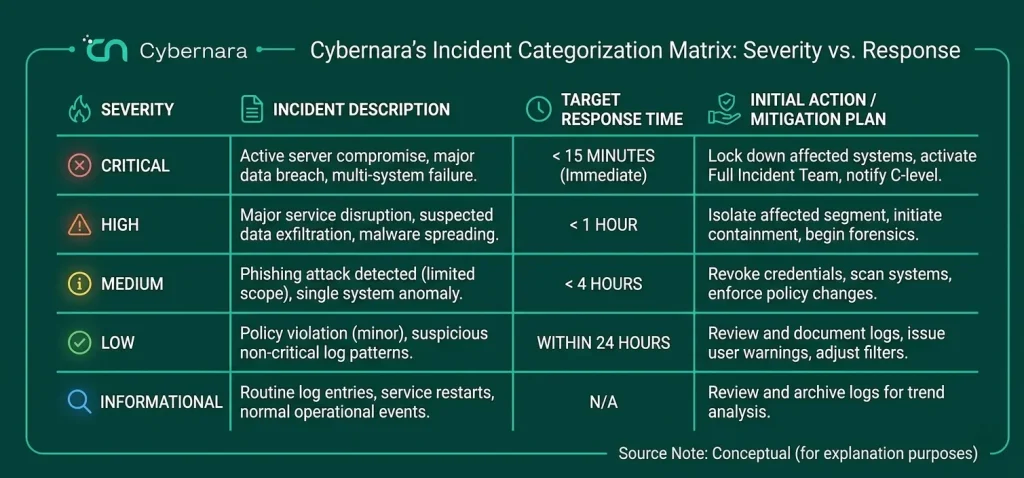
Cybernara's Incident Categorization Matrix
Where IT and Infrastructure Actually Support Your Business
IT infrastructure is not just servers and networks sitting in the background. It quietly supports every workflow, every login, every transaction, and every decision your business makes.
Core Business Applications
Your CRM, ERP, internal tools, and customer-facing platforms all depend on stable infrastructure. When systems lag or fail, productivity drops and customer experience suffers immediately.
User Access and Identity Systems
Every employee login, permission change, and authentication request flows through your infrastructure. If identity systems are misconfigured or unmanaged, access becomes either too loose or too restrictive.
Cloud Platforms and Hybrid Environments
Modern businesses run across AWS, Azure, on-prem systems, and SaaS tools. Infrastructure ensures these environments connect, communicate, and scale without breaking under load.
Network and Connectivity Layers
From office networks to remote access and VPNs, connectivity is what keeps teams working. Poor network design leads to bottlenecks, downtime, and inconsistent performance.
Data Storage and Availability
Databases, file systems, and backups all rely on infrastructure. If storage is not optimized or protected, data becomes slow to access, vulnerable to loss, or difficult to recover.
Security and Monitoring Systems
Firewalls, endpoint tools, logging systems, and alerts all depend on infrastructure to function properly. Without a strong foundation, security tools become unreliable or ineffective.
What’s at Risk When Infrastructure Is Left Unmanaged
Frequent Downtime and Service Disruptions
Security Gaps and Unpatched Systems
Performance Degradation Over Time
Data Loss or Failed Recovery
Rising Operational Costs
Lack of Visibility and Control
Clients Who Trust Us







How Cybernara Brings Structure to Your IT Environment
Clear Ownership and Responsibility
Documented Architecture and Workflows
Consistent Processes for Changes and Updates
Centralized Visibility Across Systems
Reduced Dependency on Individual Knowledge
Why Cybernara Doesn’t Treat Infrastructure as Just Support
Most providers treat infrastructure as a support function — something to fix when it breaks. We treat it as a critical part of how your business operates and grows.
Focus on Business Impact, Not Just Systems
We don’t just look at servers and networks — we look at how they affect your workflows, teams, and customers. Every improvement is tied back to business outcomes.
Proactive Instead of Reactive Approach
Instead of waiting for issues, we identify and resolve risks early. This reduces downtime, prevents disruptions, and keeps your operations running smoothly.
Built for Real-World Complexity
Your environment is not perfect — and we don’t expect it to be. We work with real setups, legacy systems, and hybrid environments without forcing unrealistic changes.
Long-Term Stability Over Quick Fixes
Quick fixes create long-term problems. We prioritize solutions that last, even if they take slightly more effort upfront.
Integrated with Security and Compliance Needs
Infrastructure and security go hand in hand. We ensure your systems are not only stable but also aligned with security best practices and compliance requirements.
A Partner, Not Just a Service Provider
We don’t disappear after setup. We stay involved, continuously improving and adapting your infrastructure as your business evolves.
Services Our Clients Trust Us With
Our Core Services
IT and Infrastructure Services
Cloud and Platform Services
Security and Compliance Services
Development, Data and AI Services
Protect Your Data, People & Business From Threat Attacks
Get Started With A Free Security Audit
FAQs
How long does it take to stabilize or improve our infrastructure?
Most environments start seeing stability improvements within the first few weeks. Deeper optimization, modernization, and performance tuning typically happen over 60 to 90 days depending on complexity.
Do we need to replace our existing infrastructure completely?
Not at all. We work with what you already have, identify gaps, and improve it step by step. In many cases, small changes create significant improvements without full replacement.
Who manages the infrastructure after setup or optimization?
Cybernara can fully manage your infrastructure or work alongside your internal team. We handle monitoring, maintenance, updates, and issue resolution so your team isn’t stuck firefighting.
Is this only for large enterprises, or can smaller teams benefit too?
This is valuable for both. Smaller teams benefit from not needing a large internal IT function, while larger organizations gain structure, visibility, and better control over complex environments.