
Secure Cloud and Hybrid Implementations
Our Secure Cloud and Hybrid Implementations Services Are global and Available In Multiple Countries
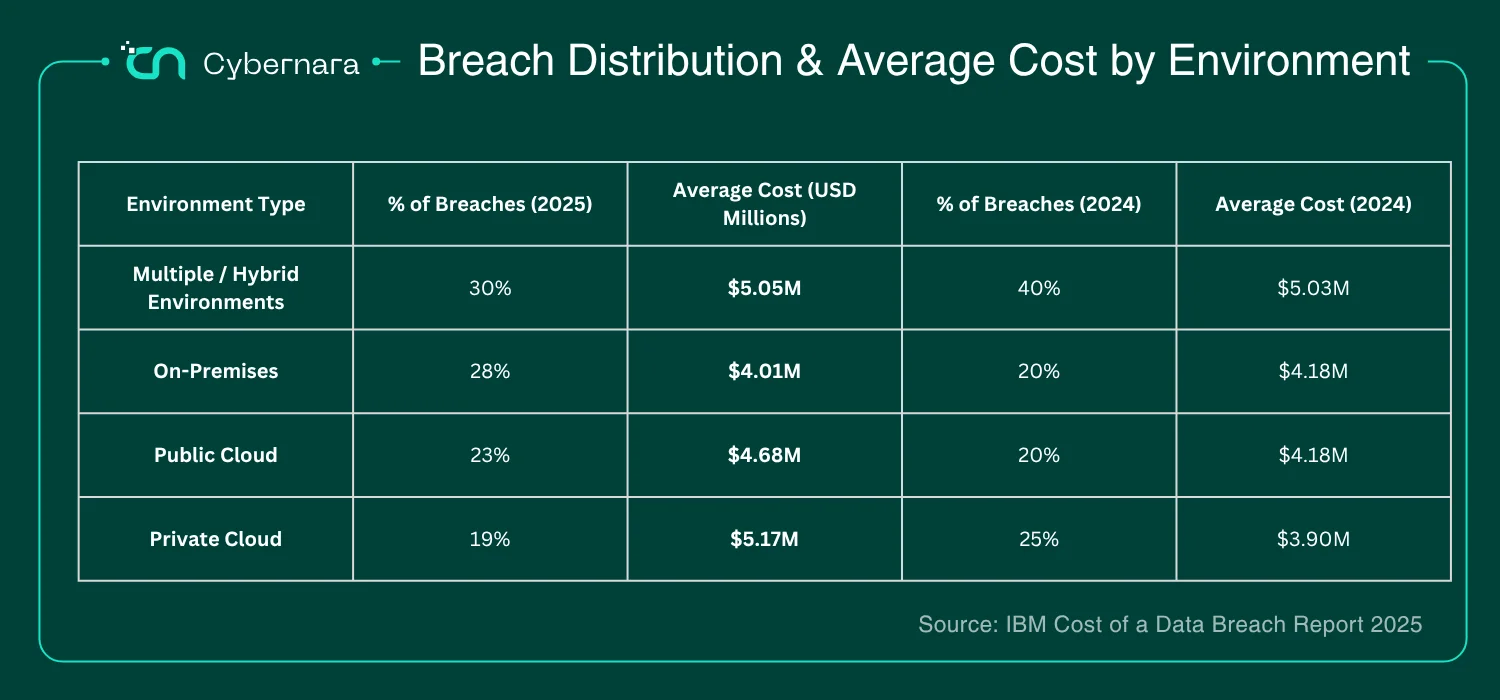
Breach Distribution & Average Cost by Environment
Hybrid and multi-cloud environments remain the most frequent targets, accounting for nearly a third of all breaches. They’re also among the costliest, reflecting the added complexity of managing security across distributed infrastructures.
Public, Private, and Hybrid — What’s the Difference?
Not all clouds are built the same, and not every organization needs the same kind of control.
Understanding how public, private, and hybrid clouds differ is the first step toward securing them — because each one changes who’s responsible for what.
Public Cloud — Shared but Scalable
Resources are owned and managed by providers like AWS, Azure, or Google Cloud.
You share infrastructure with others, but each workload is isolated through virtualization and identity controls.
It’s fast to deploy and endlessly scalable, but you trade physical control for convenience and must rely heavily on proper configurations and permissions.
Private Cloud — Controlled but Complex
Built exclusively for one organization, either on-premise or in a dedicated data center.
It offers deeper control over data, compliance, and custom configurations — but requires significant upkeep and in-house expertise.
Security depends less on the provider and more on how well internal teams manage access, patching, and infrastructure updates.
Hybrid Cloud — The Best (and Hardest) of Both
Combines public scalability with private control.
Workloads move between environments — say, sensitive data in a private cloud and computation in a public one.
The flexibility is unmatched, but so is the complexity. Security has to follow the workload across networks, identities, and governance boundaries.
Each model works differently, but the common truth is this: the more distributed your systems become, the more your security depends on coordination, not just configuration.
How Threats and Security Differ Across Public, Private, and Hybrid Clouds
Public Cloud — Configuration Is the New Perimeter
Private Cloud — Trust Is the Weakest Link
Hybrid Cloud — Complexity Creates the Gaps
Every cloud model has its advantages, but the attack surface expands in proportion to flexibility. Securing them isn’t about choosing the safest one — it’s about knowing where the risks shift when control changes hands.
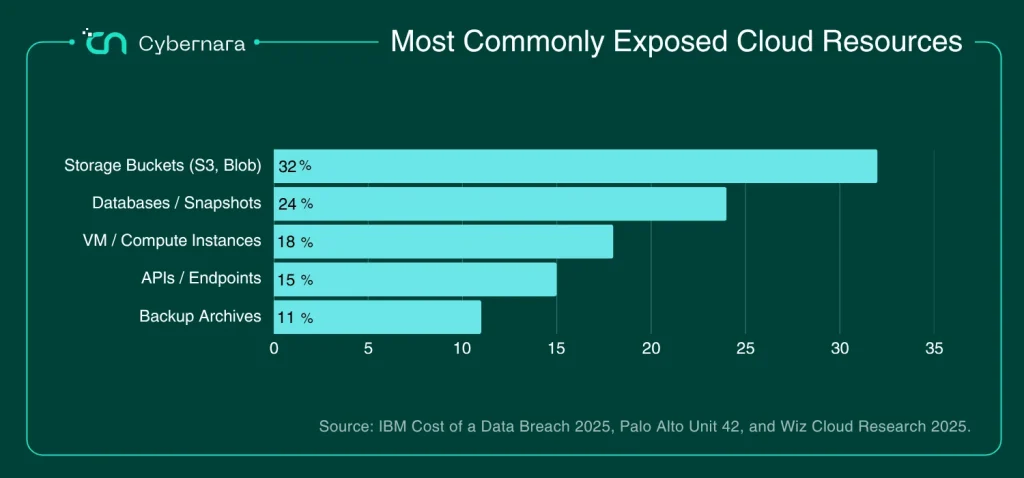
Most Commonly Exposed Cloud Resources
Cloud breaches rarely target obscure assets — they go after what’s left open most often.
Misconfigured storage buckets, exposed databases, and unsecured APIs continue to dominate exposure incidents, proving that visibility and access control remain the first lines of defense.
Clients Who Trust Us







The Layers of a Secure Cloud Architecture
Identity and Access Layer
Network and Segmentation Layer
Data Protection Layer
Application and Workload Layer
Monitoring and Response Layer
Governance and Compliance Layer
End-to-End IT and Security Support with Cybernara
No single platform can guarantee perfect security, but Cybernara helps organizations build a cloud environment that is secure, controlled, and continuously monitored across every critical layer. Our approach goes beyond managing tools or isolated configurations. We connect security controls across public, private, and hybrid cloud environments to create a unified and resilient defense strategy.
Here is what that coverage looks like in practice:
Identity and Access Management
Security begins with controlling access. Cybernara applies least-privilege principles across users, service accounts, applications, and administrative access. Centralized identity governance helps reduce unnecessary permissions, eliminate shared credentials, and improve visibility across cloud and on-premise environments.
Configuration Management and Compliance
Misconfigurations remain one of the most common causes of cloud security incidents. We continuously assess cloud environments against recognized frameworks such as CIS, NIST, and ISO to maintain secure configurations, strengthen compliance posture, and support audit readiness.
Data Protection and Privacy Controls
Protecting sensitive information requires more than encryption alone. Cybernara helps secure data across databases, storage platforms, backups, and shared workloads through encryption management, classification policies, access controls, and continuous monitoring.
Network and Workload Security
Modern cloud environments depend on strong segmentation and workload isolation. We implement zero-trust principles that reduce unnecessary exposure, limit lateral movement, and continuously monitor workloads and network activity across multiple cloud providers and regions.
Centralized Monitoring and Incident Response
Visibility is essential for effective security operations. Our monitoring approach brings together cloud logs, API activity, identity systems, and security events into a centralized view that helps teams detect, investigate, and respond to threats more efficiently.
Governance and Operational Alignment
Security is most effective when technology, processes, and people work together. Cybernara helps organizations align policies, responsibilities, and operational workflows so security becomes part of daily operations rather than a disconnected compliance exercise.
Cloud security is not achieved through a single tool or one-time project. It requires structured governance, continuous monitoring, and coordinated controls across the entire environment. Cybernara helps organizations build that foundation in a way that supports both security and long-term business growth.
Services Our Clients Trust Us With
Our Core Services
IT and Infrastructure Services
Cloud and Platform Services
Security and Compliance Services
Development, Data and AI Services
Protect Your Data, People & Business From Threat Attacks
Get Started With A Free Security Audit
FAQs
Which cloud environment is the most secure?
No environment is inherently safest — security depends on how well configurations, access controls, and monitoring are maintained.
A properly managed hybrid setup can be as secure as a private one.
Are misconfigurations still the biggest cloud risk?
Yes. Over one in five cloud breaches begin with a misconfiguration often from public access settings, weak IAM roles, or forgotten storage buckets.
Does Cybernara work with all major cloud platforms?
Yes. We design and secure environments across AWS, Azure, Google Cloud, and private infrastructures, ensuring policies stay consistent in multi-cloud and hybrid setups.
Will implementing cloud security controls slow down operations?
Not at all. Our approach uses automation and policy templates that integrate with your existing CI/CD pipelines. Security becomes part of your process — not an obstacle to it.