
Custom Software and Web Applications
Cybernara's Application Lifecycle Framework
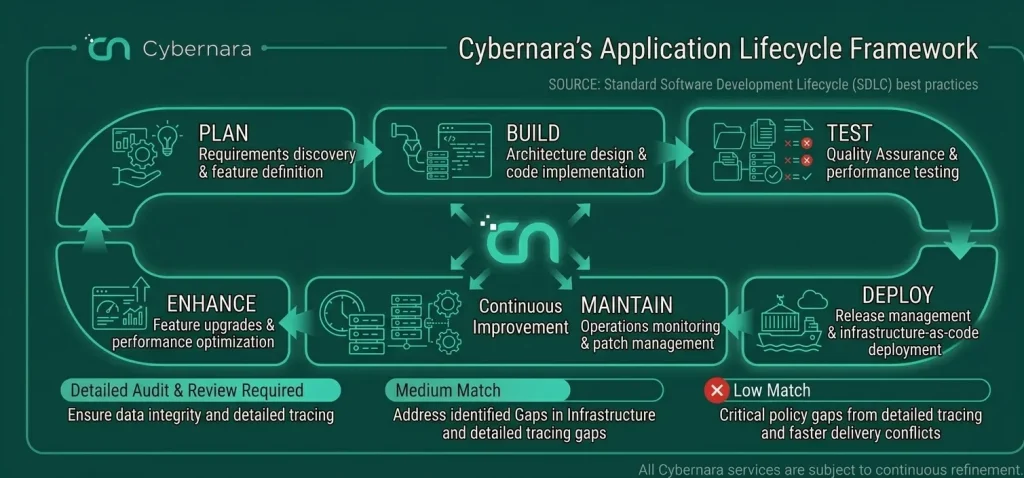
The Hidden Inefficiencies in Off-the-Shelf Tools
Off-the-shelf software works — until it doesn’t. Over time, small mismatches between the tool and your workflow turn into daily inefficiencies.
Processes Don’t Fit the Tool
Teams are forced to adapt their workflows to match the software. This creates extra steps and unnecessary complexity.
Workarounds Become the Norm
Users rely on spreadsheets, manual tracking, or parallel systems to fill gaps. These workarounds increase effort and risk.
Limited Flexibility and Customization Generic tools can’t adapt to specific business needs. Important requirements are left unaddressed.
Data Is Scattered Across Systems
Multiple tools store related information separately. This makes reporting and decision-making harder.
Integration Challenges Slow Down Operations
Systems don’t connect seamlessly. Teams spend time moving data instead of using it.
Scaling Becomes Difficult Over Time
As the business grows, the tool struggles to keep up. Limitations become more visible and impactful.
Where Custom Applications Actually Support Your Operations
Internal Business Processes and Workflows
Customer-Facing Platforms and Portals
Data Management and Reporting Systems
Integration Between Existing Systems
Operational Dashboards and Monitoring Tools
Mobile and Remote Access Applications
Clients Who Trust Us


How Cybernara Builds Software That Actually Fits Your Workflow
Understanding Your Processes First
Designing Around Usability and Simplicity
Modular and Scalable Architecture
Seamless Integration With Existing Systems
Iterative Development and Feedback Loops
When Software Requirements Do Not Match Business Needs
When software does not align with business operations, the impact often develops gradually rather than appearing immediately. Over time, inefficiencies, disconnected workflows, and operational friction begin affecting productivity, accuracy, scalability, and overall business performance.
Reduced Productivity Across Teams
Manual processes, disconnected systems, and inefficient workflows slow down daily operations. Teams spend valuable time managing workarounds and repetitive tasks instead of focusing on higher-value work.
Increased Errors and Data Inconsistencies
Temporary fixes and manual data handling frequently introduce mistakes and inconsistencies. As data reliability decreases, reporting accuracy and operational confidence are affected.
Growing Operational Costs
Inefficient systems increase the time, effort, and resources required to complete routine activities. Operational costs continue rising without delivering equivalent improvements in business outcomes.
Limited Visibility and Delayed Decision-Making
When information is spread across disconnected platforms, obtaining clear and timely insights becomes difficult. Decision-making slows down and may rely on incomplete or outdated information.
Difficulty Scaling Business Operations
Software that does not support operational requirements becomes increasingly difficult to scale as the organization grows. Expansion efforts become more complex, less efficient, and harder to manage consistently.
Poor User Experience and Reduced Adoption
Systems that create friction in daily workflows lead to frustration among users and lower adoption rates. This impacts collaboration, efficiency, and the overall effectiveness of the software environment.
Long-term operational success depends on systems that support how the business actually functions. Software should simplify processes, improve visibility, and enable growth rather than introducing additional complexity and operational overhead.
Services Our Clients Trust Us With
Our Core Services
IT and Infrastructure Services
Cloud and Platform Services
Security and Compliance Services
Development, Data and AI Services
Protect Your Data, People & Business From Threat Attacks
Get Started With A Free Security Audit
FAQs
What is meant by custom software and web applications?
It refers to applications built specifically for your business needs — whether internal tools, customer-facing platforms, or integrations between systems.
How is this different from off-the-shelf software?
Off-the-shelf tools are built for general use. Custom applications are designed around your exact workflows, processes, and requirements..
Can you integrate with our existing systems?
Yes. We design applications that connect with your current tools, databases, and platforms to avoid disruption.
Who maintains the application after development?
Cybernara can manage, support, and continuously improve the application, or work alongside your internal team.