
DPDP Act: Protecting Personal Data Powering India's Digital Growth
The Digital Personal Data Protection (DPDP) Act, enacted in 2023, provides a legal framework to protect the personal data of Indian citizens while supporting the growth of the digital economy. It applies to businesses in India and abroad that process Indian citizens’ personal data to offer goods or services, setting rules for how this data is collected, processed, stored, and shared. The Act empowers individuals with greater control over their data and imposes strict obligations on organizations to ensure data privacy and security.
Compliance Clock is Ticking!
Immediate (Effective Nov 13, 2025)
Definitions, DPB setup, governance, procedures (Rules 1-2, 17-21)
Within 12 Months (By Nov 13, 2026)
Consent Manager registration (Rule 4)
Within 18 Months (By May 13, 2027)
Core operational compliance (Rules 3, 5-16, 22-23)
Download the DPDPA Guide
DPDPA can feel overwhelming when read as a legal document.
We simplified the Act, its obligations and penalties, into easy-to-understand guide for business team
DPDP Act FAQs for Businesses
Most businesses have the same questions about DPDPA. Does it apply to us? What about WhatsApp?
This PDF answers the most common, real-world questions in plain language.
Got Data?
Got Infra?
Got Cloud?
We protect it all.
Security that works actively in the background.
Cloud • Infrastructure • Platforms • APIs • Networks • Data • Applications • Endpoints • Identities • Workloads • Logs • Access • Integrations • Storage • Environments • Logs
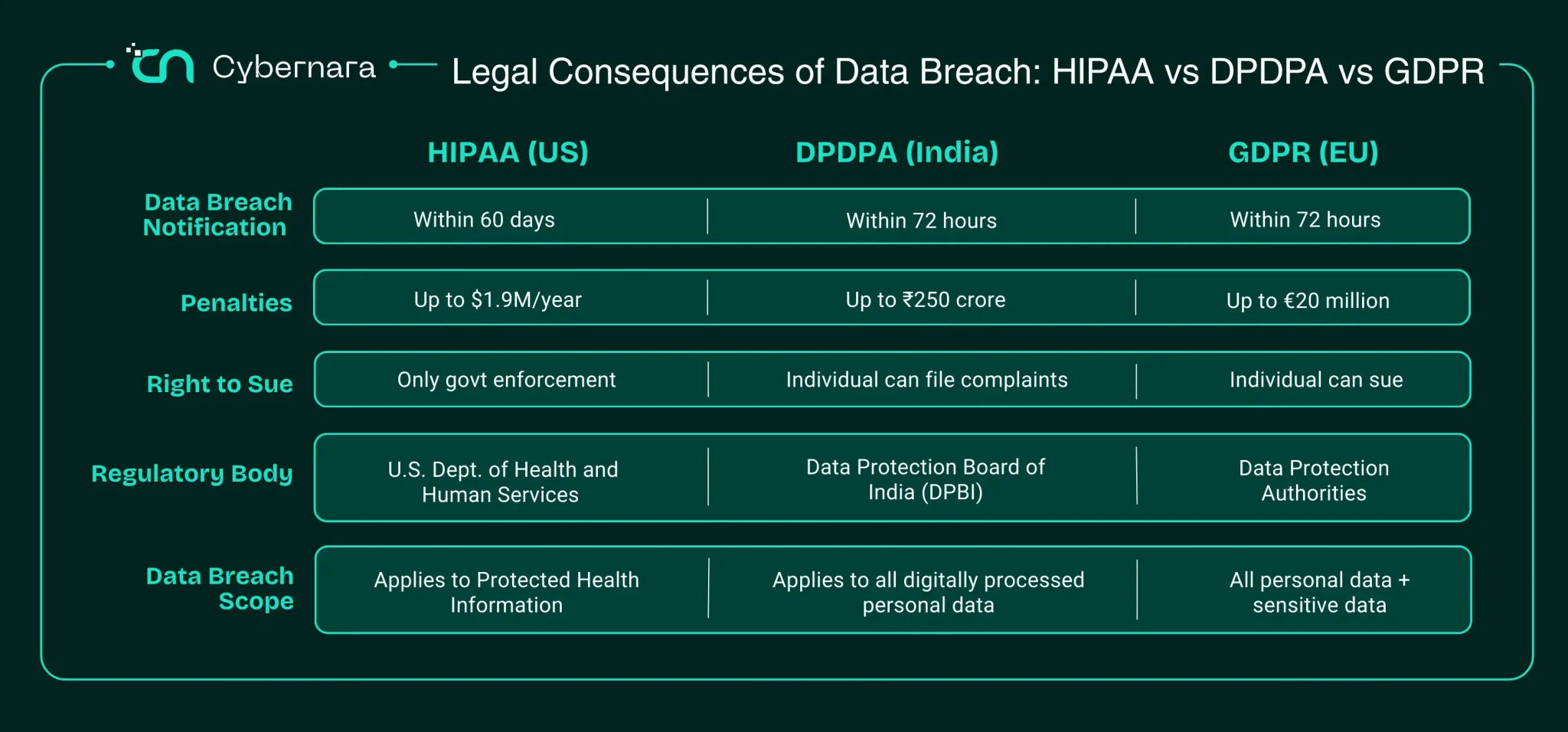
Legal Consequences of Data Breach: HIPAA vs DPDPA vs GDPR
Breach response is measured in hours, not weeks. DPDPA expects prompt intimation and detailed reporting within tight windows, similar to GDPR’s 72-hour regulator clock, while HIPAA has its own deadlines and reporting rules. This is why “being prepared” matters more than “having a policy.”
Cybernara DPDPA Compliance Services
We help teams figure out where they stand on DPDPA, fix the gaps, and stay prepared for what comes next.
DPDP Readiness and Gap Assessment
Identify gaps against DPDPA requirements across data flows, systems, processes, and policies.
Implementation and Remediation
Implement controls and fixes to meet DPDPA requirements.
Virtual DPO as a Service
On-demand DPO support without full-time overhead.
Incident and Breach Response Support
Support for breach assessment and DPDPA response readiness
Training and Awareness
Practical DPDPA training for employees and stakeholders.
Why DPDPA Compliance Matters for Indian Businesses
Customers are increasingly aware of privacy risks. If your business cannot explain what data you collect and why, trust drops fast. DPDPA pushes you to build clarity and control, which directly improves customer confidence and reduces reputation damage during incidents.
Brand Risk Is Now Triggered by Small Events
Customers are increasingly aware of privacy risks. If your business cannot explain what data you collect and why, trust drops fast. DPDPA pushes you to build clarity and control, which directly improves customer confidence and reduces reputation damage during incidents.
Enterprise and Vendor Requirements Are Getting Stricter
Large clients and partners are asking privacy questions earlier in procurement. They want proof of consent handling, request workflows, retention rules, and vendor oversight. DPDPA compliance helps you pass privacy due diligence and reduces delays during onboarding and renewals.
Penalty Exposure Becomes Real When You Cannot Prove Control
Penalties are not just about the maximum number. The real risk is failing to show evidence of consent, safeguards, and timely action when a complaint, request, or incident occurs. A business that cannot produce proof and audit trails is exposed even if it believes it is “doing the right thing.”
Data Sprawl Creates Hidden Operational Cost
Personal data spreads across tools, teams, and vendors over time. Without a privacy system, data copies multiply and control gets weaker. DPDPA readiness forces consolidation, ownership, and lifecycle rules, which reduces confusion, improves security posture, and prevents costly cleanup later.
Who Needs DPDPA Compliance Services in India?
SaaS and technology companies
They process user identifiers, usage analytics, support tickets, and integration data across multiple tools and vendors.
BFSI and fintech
They process identity data, KYC records, transaction data, and high-impact personal information under strict scrutiny from customers and regulators.
Healthcare and wellness
They handle patient identifiers, health-related records, appointment platforms, lab partners, and sensitive operational workflows.
Retail and e-commerce
They process orders, delivery addresses, contact information, payments, refunds, and customer support interactions at scale.
Edtech and platforms
They handle user accounts, student data, learning progress data, messaging, community tools, and third-party integrations.
DPDPA applies to all industries dealing with customer data from India.
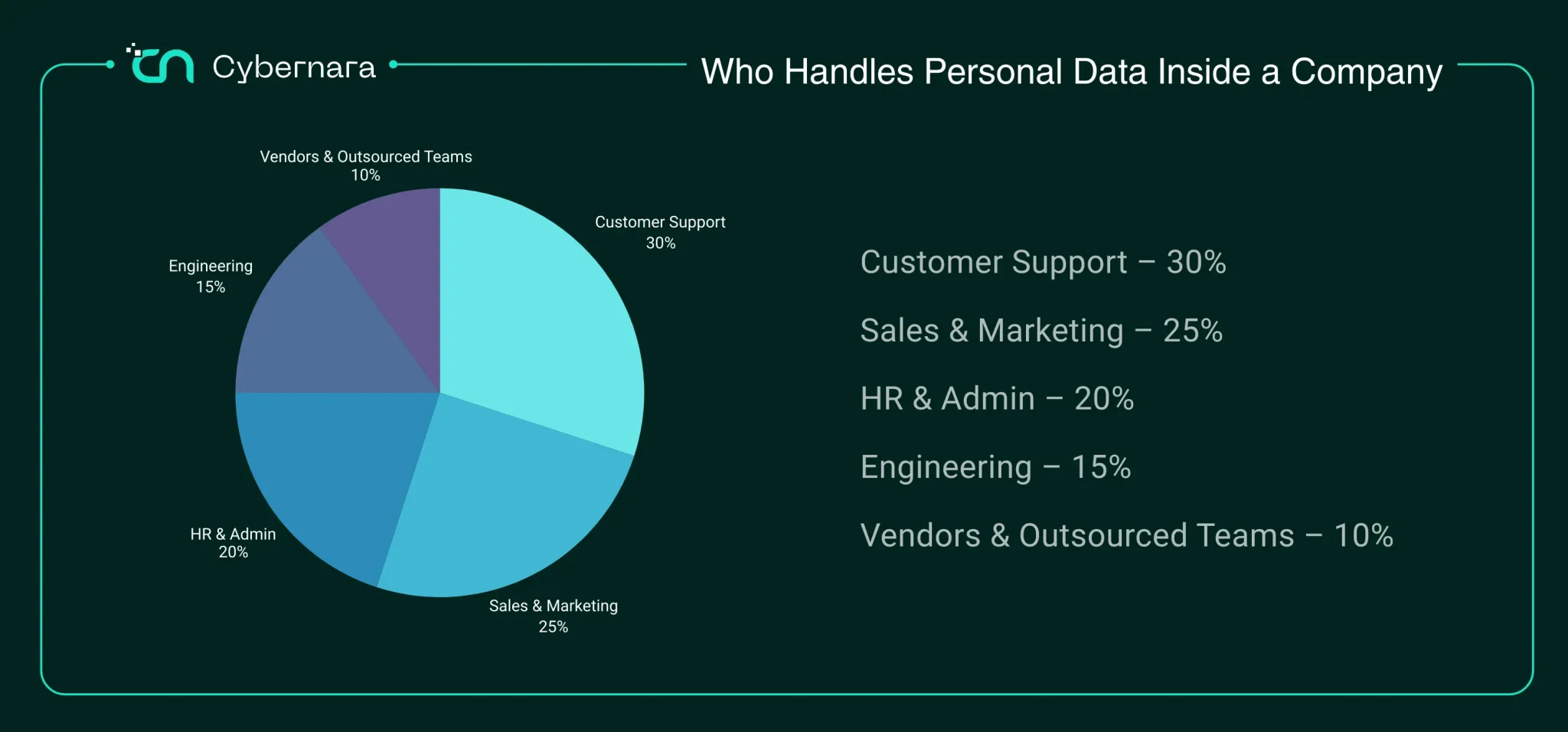
Who Handles Personal Data Inside a Company?
Personal data is not handled by one team. It moves daily through support, sales, HR, engineering, and vendors. DPDPA compliance only works when controls extend beyond IT into every function that touches data.
Clients Who Trust Us







Core DPDPA Requirements (Plain English Checklist)
Notice and Consent (the starting point)
DPDPA compliance starts where data collection starts. You must tell people what you are collecting and why, using clear and understandable notice. Consent should be specific and purposeful, not buried in long, vague language. The most important operational requirement is that withdrawal of consent must be as easy as giving consent. That means the business must build a real workflow to stop processing, update systems, and record proof of withdrawal.
Data Principal Rights + Grievance Redressal
DPDPA requires you to operationalize the rights of the Data Principal. This includes enabling access, correction, and erasure requests, as well as handling grievances and nomination-related requests where applicable. The challenge is not legal interpretation. The challenge is operational response. Your teams need defined intake, identity verification, search, response, and closure evidence steps. Without a system, these requests become chaotic and inconsistent.
Security Safeguards + Breach Readiness
DPDPA expects “reasonable security safeguards.” In plain terms, this means you must protect personal data against unauthorized access, misuse, alteration, and loss. This usually requires access controls, encryption where appropriate, logging, monitoring, secure configuration, and strong incident handling. Breach readiness means you can scope the incident fast, identify what personal data was impacted, preserve evidence, coordinate internal response, and execute a notification process when required. Most organizations struggle here because breach processes exist, but privacy-specific evidence is missing.
Vendor, Processor, and Third-Party Controls
Most DPDPA risk lives outside the core product. Vendors and processors often handle more personal data than expected. DPDPA compliance requires you to maintain processor oversight through agreements, due diligence, and continuing monitoring. This includes Data Processing Agreements, vendor risk reviews, access limitation, auditability, and clearly defined responsibilities for breach handling and request response. If vendors are unmanaged, your compliance posture is not stable.
Cybernara’s 360° DPDPA Compliance Approach
Discover
We map your personal data footprint across apps, websites, HR systems, CRMs, support tools, cloud environments, and vendors. We identify where data is stored, where it flows, who accesses it, and where it escapes control.
Design
We convert DPDPA requirements into practical workflows. Notices, consent capture and withdrawal, request handling, grievance processes, retention rules, breach response evidence, vendor governance, and accountability. Everything is designed to fit your tools and team structure.
Deliver
We deliver the artifacts and implementation roadmap your team can execute. Policy packs, registers, templates, workflows, and a prioritized implementation plan that aligns with real operational bandwidth.
Operate
We help keep it alive. Ongoing monitoring, internal audits, evidence updates, vendor rechecks, training refreshers, and readiness reviews. This is where most compliance programs fail, so the operating model matters as much as the initial build.
As DPDPA rules and enforcement timelines roll out in phases, the approach should match that reality. Start with control points that are foundational and visible to regulators and enterprise clients first. Notice and consent, data discovery, request handling, breach readiness, and vendor governance.
DPDPA applies to all industries dealing with customer data from India.
Services Our Clients Trust Us With
Our Core Services
IT and Infrastructure Services
Cloud and Platform Services
Security and Compliance Services
Development, Data and AI Services
Securing Teams Since 2019
Get Started With A Free Security Audit
FAQs
Why does DPDPA focus on multiple teams, not just IT or security?
Because personal data is handled across business functions, not stored in one place. Customer support, sales, HR, engineering, and vendors all access personal data daily. DPDPA compliance fails when controls exist only in IT while data flows freely elsewhere.
Engineers sometimes use production data for debugging. Is that allowed?
It depends on how it is done. Using live personal data without safeguards increases risk. DPDPA pushes teams toward access minimization, masking, or controlled workflows so engineering work does not expose more data than necessary.
Sales and marketing keep exporting data to spreadsheets. Is that a real DPDPA risk?
Yes. Spreadsheets are one of the most common sources of data leakage. Once data leaves the system of record, it becomes harder to control retention, sharing, and deletion. DPDPA compliance requires knowing where those copies go and limiting unnecessary exports.
Do vendors really count as our responsibility under DPDPA?
Yes. If a vendor processes personal data on your behalf, you remain accountable. This includes payroll providers, CRM platforms, email tools, cloud vendors, and outsourced support teams. If they mishandle data, regulators will look at your oversight first.