
Incident Response & Digital Forensics
Our Incident Response & Digital Forensics Services Are global and Available In Multiple Countries
Mean Time to Identify & Contain a Breach
Most breaches go unnoticed for months. Attackers sit inside systems quietly, moving laterally, collecting data, and waiting for the right moment to strike. Faster incident response cuts this dwell time dramatically — reducing damage, stopping spread, and lowering the total impact of the breach.

What Businesses Struggle With During an Incident
When an incident begins, it arrives disguised as a minor glitch, a strange login, a system running slower than usual. In those early moments, uncertainty becomes the biggest adversary.
Businesses are forced to act while still trying to understand what they are facing — and that tension between urgency and ambiguity is where the real struggle begins.
Not Knowing Where the Incident Truly Started
The first visible sign is almost never the first event. By the time something looks wrong, the real beginning is already buried in earlier, quieter actions.
Noise Overwhelms the Signals That Matter
Alerts stack up, logs overflow, and every system starts shouting at once. Deciding which clue is the real one becomes harder than finding more clues.
Internal Teams Freeze Between Damage and Doubt
People hesitate — unsure whether to pull systems offline, revoke access, or wait. Every choice feels risky, and every delay feels dangerous.
Communication Becomes Scattered and Emotional
Teams scramble, messages multiply, and assumptions spread faster than facts. In the confusion, small misunderstandings create bigger problems.
Evidence Is Lost in the Rush to Fix Things
Systems get rebooted, logs get overwritten, and traces disappear while trying to “make things work again,” often erasing the very answers needed later.
During an incident, the hardest part isn’t the threat itself — it’s navigating the unknown while trying to protect what matters.
The Role of Forensics in Understanding an Attack
It Reconstructs the Path No One Saw
It Separates Coincidence From Intent
It Reveals the Entry Point Long After It Happened
It Shows What the Attacker Tried to Hide
It Connects the Attack to Its Methods and Motives
Forensics doesn’t undo the incident — it explains it. It turns uncertainty into insight, giving an organization the truth it needs to rebuild with confidence.
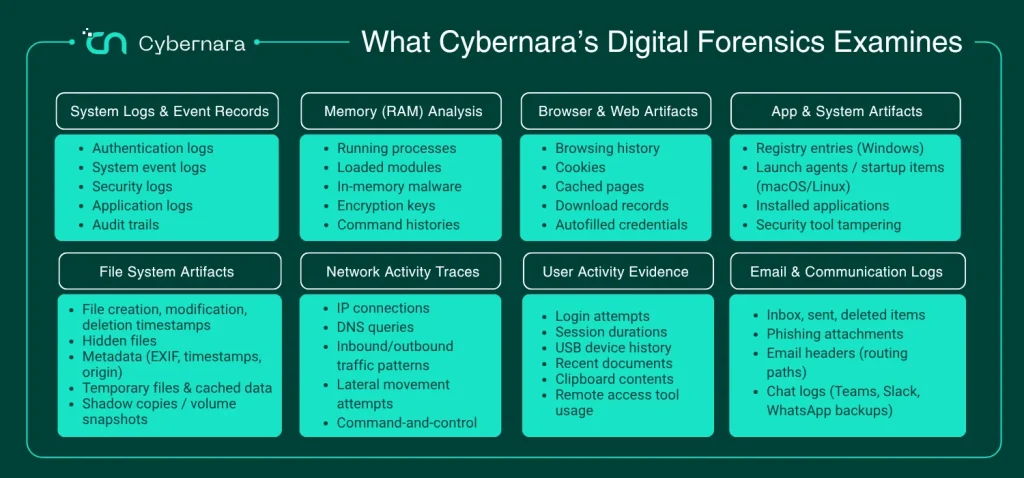
What Cybernara’s Digital Forensics Examines
Digital forensics works by examining the traces an attacker leaves behind — logs, artifacts, memory, network paths, and subtle changes hidden in the system. Each evidence source reveals a small part of the story, and together they help reconstruct what truly happened.
Clients Who Trust Us







What Our Incident Response Team Covers
We Handle Malware and Ransomware Containment
We Investigate Identity and Account Compromises
We Respond to Cloud and Email-Based Attacks
We Address Insider Threats and Suspicious User Activity
We Handle Vulnerability Exploits and System Intrusions
We Assess Data Exposure and Possible Exfiltration
The Operational Impact of Digital Forensics
After an incident is contained, organizations need clear answers about what happened, how the attack spread, and what actions are required next. Digital forensics provides those answers through evidence-based investigation rather than assumptions or incomplete information.
It transforms uncertainty into a clear understanding of the incident, helping businesses recover with confidence and strengthen their security posture moving forward.
Identifying How the Incident Started
Digital forensics helps determine the exact entry point of the attack, whether it originated from compromised credentials, phishing activity, vulnerable services, misconfigurations, or another attack vector. Understanding the root cause allows organizations to address the actual weakness instead of only treating visible symptoms.
Reconstructing the Full Timeline of Activity
Investigators analyze logs, system artifacts, network activity, and forensic evidence to rebuild the attacker’s actions step by step. This creates a detailed timeline showing when access occurred, what systems were affected, how the attacker moved through the environment, and what actions were attempted.
Understanding the Real Impact of the Incident
Forensics helps determine what information, systems, or services were accessed, modified, or exfiltrated. This allows organizations to separate low-risk activity from meaningful exposure and accurately assess the scope of the incident.
Supporting Compliance, Legal, and Reporting Requirements
Many industries require formal documentation and defensible evidence following a security incident. Forensic investigations provide the records and analysis needed for regulatory reporting, legal review, insurance claims, and internal governance processes.
Strengthening Security Through Lessons Learned
Every incident reveals opportunities for improvement, including missing security controls, weak configurations, overprivileged accounts, or overlooked alerts. Forensic findings help organizations improve defenses, reduce future risk, and strengthen operational resilience.
Digital forensics provides clarity after an incident by uncovering what actually happened and why. This enables organizations to make informed decisions, recover more effectively, and build stronger security practices for the future.
Services Our Clients Trust Us With
Our Core Services
IT and Infrastructure Services
Cloud and Platform Services
Security and Compliance Services
Development, Data and AI Services
Protect Your Data, People & Business From Threat Attacks
Get Started With A Free Security Audit
FAQs
How do I know if our systems are experiencing a security incident?
Unexpected logins, locked accounts, missing data, unknown processes, or systems behaving oddly are all early signs. If something feels wrong, it usually is — and fast response matters more than certainty.
What is the list of things digital forensics actually examine?
Everything that reveals the truth: logs, file activity, memory artifacts, network behavior, authentication trails, registry changes, and any traces the attacker left behind. Every detail helps rebuild the full timeline.
Can you work with our internal IT team?
Absolutely. We coordinate closely with your IT, DevOps, and cloud teams. You stay in control, and we handle the technical depth while keeping everyone aligned.
Do you help with regulatory notifications or insurance reporting?
Yes. Forensic findings are structured to meet compliance, legal, and insurance requirements. You get clear, defensible documentation of everything that happened.