
IT Facility Management Services
Asset and Support Management Matrix
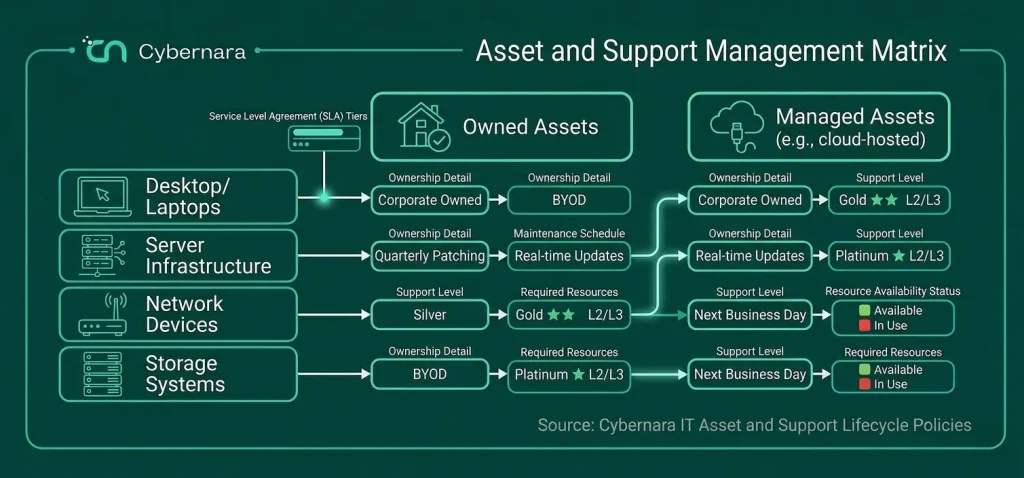
Where ITFMS Actually Supports Your Daily Operations
IT doesn’t sit in one place. It runs across every system, device, and workflow your business depends on — often unnoticed until something breaks.
User Devices and Workstations
Laptops, desktops, and mobile devices are where work actually happens. ITFMS ensures they stay updated, secure, and running without slowing users down.
Servers and Core Systems
Business-critical applications and databases rely on stable servers. ITFMS keeps them patched, monitored, and performing consistently.
Networks and Connectivity
Every login, file transfer, and application depends on reliable connectivity. ITFMS manages network performance, reducing downtime and bottlenecks.
Applications and Business Tools
Internal tools, third-party apps, and platforms need to work together smoothly. ITFMS ensures compatibility, updates, and issue resolution across all applications.
Data Storage and Backup Systems
Data needs to be available and recoverable at all times. ITFMS maintains storage systems and ensures backups are consistent and usable when needed.
Access and Identity Systems
User access across systems must be controlled and traceable. ITFMS manages provisioning, deprovisioning, and access controls to reduce risk.
Why Cybernara Doesn’t Treat IT as Just Support
Focused on Business Continuity, Not Just Tickets
Designed for Real-World Environments
Stability Comes Before Complexity
Continuous Management, Not One-Time Fixes
Reduced Dependency on Internal Teams
Clear Visibility and Control
Clients Who Trust Us





How Cybernara Bring Structure to Your IT Operations
Complete Environment Visibility
Centralized Monitoring and Alerts
Standardized Configurations and Processes
Proactive Maintenance and Updates
Defined Ownership and Accountability
The Limitations of Reactive IT Support
Fixing issues only after they occur may seem manageable in the short term, but over time it leads to instability, inefficiency, and increased operational risk.
Issues Are Identified Too Late
Without proactive monitoring, problems are often discovered only after users are impacted. By that point, the issue may have already affected multiple systems or workflows.
Recurring Problems Continue Unresolved
When only immediate symptoms are addressed, the same issues keep returning. Teams end up spending time on repetitive firefighting instead of long-term improvements.
Limited Visibility Into System Health
Without continuous oversight, it becomes difficult to understand the overall health of systems and infrastructure. Small issues can accumulate unnoticed until they become larger problems.
Downtime Starts Becoming Routine
Frequent disruptions gradually become accepted as normal. This affects productivity, slows operations, and reduces confidence in system reliability.
Security Risks Remain Hidden
Reactive environments often overlook vulnerabilities, outdated configurations, and unmanaged systems. Over time, these gaps increase the likelihood of security incidents.
IT Teams Become Constantly Overloaded
Continuous issue resolution leaves little room for optimization or strategic improvements. Teams operate in a reactive cycle that becomes stressful and inefficient.
Services Our Clients Trust Us With
Our Core Services
IT and Infrastructure Services
Cloud and Platform Services
Security and Compliance Services
Development, Data and AI Services
Protect Your Data, People & Business From Threat Attacks
Get Started With A Free Security Audit
FAQs
How long does it take to stabilize an IT environment under ITFMS?
Most environments start seeing improvements in stability and issue reduction within the first few weeks. Full standardization and optimization typically take 60 to 90 days depending on size and complexity.
Do we need to replace our existing tools or infrastructure?
No. We work with your current setup and improve it step by step. The focus is on making your existing systems stable, secure, and easier to manage.
Does ITFMS cover both hardware and software environments?
Yes. ITFMS covers endpoints, servers, networks, applications, and supporting systems. It ensures everything works together as one managed environment.
What happens when something fails or goes down?
We put monitoring and escalation processes in place so issues are detected early and handled quickly. Instead of reactive firefighting, you get structured incident response.