
Cloud Security Assessment Australia
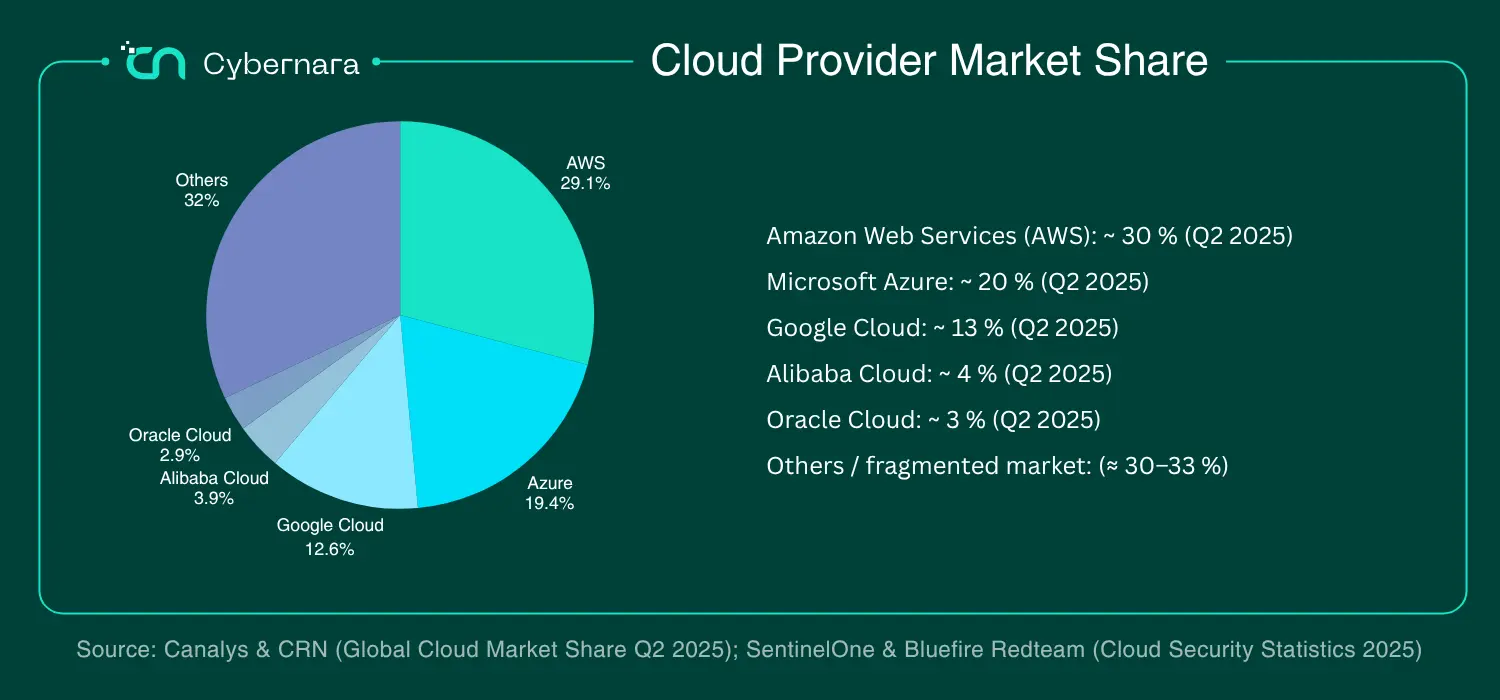
Cloud Provider Market Share
With AWS holding around one-third of the global cloud infrastructure market, its dominance also makes it a larger target for attackers and misconfigurations alike. The bigger the platform, the more visibility it attracts — and in cloud security that means a higher potential for impact.
Real Incidents That Started with Simple Cloud Mistakes
Most cloud breaches don’t start with advanced attacks, they start with a small oversight.
A single misconfigured setting, an exposed bucket, or a forgotten access key is often all it takes to open the door.
These incidents show how simple errors in the cloud can quickly turn into large-scale compromises:
Capital One (2019)
A firewall misconfiguration on AWS allowed an attacker to access credit applications containing names, addresses, and social security numbers.
It wasn’t a flaw in AWS — it was a misstep in how the cloud was set up.
Damage: Over 100 million records exposed and $190 million in penalties.
Toyota (2023)
A development database used by Toyota’s cloud team was left publicly accessible for years. It contained location data and internal service logs.
The breach wasn’t due to hacking — it was due to a missing access control.
Damage: Millions of customer records potentially exposed.
Microsoft (2022)
A misconfigured Azure endpoint used for internal testing leaked data from customer storage accounts.
Attackers didn’t break in; they simply found what wasn’t supposed to be visible.
Damage: Sensitive data from over 65,000 entities accessed.
Uber (2022)
An attacker gained access to Uber’s internal cloud resources through stolen credentials. The problem wasn’t the platform — it was lack of proper MFA enforcement and monitoring.
Damage: Access to code repositories and sensitive data, along with $148 million in legal costs.
Each of these breaches had something in common — they could have been caught early through a proper Cloud Security Assessment.
The Hidden Costs of Cloud Misconfigurations in Australia
Unexpected Expenses
Compliance Penalties
Operational Downtime
Reputational Impact
Lost Productivity
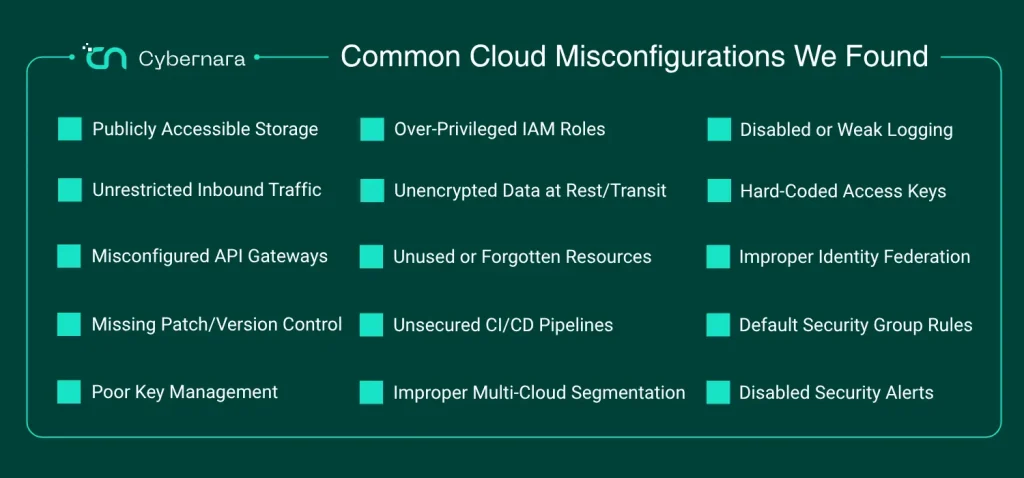
Common Cloud Misconfigurations We Found
Over the past five years of auditing cloud environments across industries, we’ve noticed the same issues repeating — regardless of the platform or scale. These misconfigurations often start small but quietly open doors for data leaks, privilege misuse, or compliance gaps.
Our engineers maintain a detailed checklist and step-by-step remediation guide to help clients fix each of these before they turn into incidents.
Clients Who Trust Us







What Average Australian Cloud Assessments Miss
Privilege Creep
Shadow Resources
Cross-Account Risks
Ineffective Logging
False Compliance Confidence
How Cybernara Handles These Gaps
We don’t rely on automated dashboards alone. Our engineers combine advanced tools with manual validation to uncover issues that standard assessments miss — focusing on context, not just checklists.
Every finding is verified for impact, relevance, and real-world exploitability.
Context-Aware Analysis
Instead of treating all misconfigurations equally, we evaluate how each one affects your specific environment.
This helps prioritize high-risk issues that actually matter to your business.
Human Checks Where Machines Stop
Automated scans find the “what,” but not the “why.”
Our experts manually test configurations, IAM policies, and exposure points to validate whether they pose real threats.
Connecting the Dots Across Clouds
We correlate results across AWS, Azure, and Google Cloud to detect risks created by overlapping accounts, shared APIs, or multi-cloud drift.
Fixes You Can Actually Use
Each issue is accompanied by clear, step-by-step instructions your internal teams can act on — no vague reports, no guesswork.
Verifying the Fix, Not Just Suggesting It
We don’t stop after the first report. Our follow-up reviews verify that fixes are applied correctly and haven’t introduced new risks elsewhere.
Cybernara’s approach closes the loop between detection and defense — ensuring that once a gap is found, it stays closed.
Services Our Clients Trust Us With
Protect Your Data, People & Business From Threat Attacks
Get Started With A Free Security Audit
FAQs
Which cloud platforms do you assess?
We work across all major providers — AWS, Microsoft Azure, Google Cloud Platform, Oracle Cloud, and Alibaba Cloud — including hybrid and multi-cloud deployments.
Do I need a Cloud Security Assessment if my cloud provider already offers security features?
Yes. Cloud providers secure their infrastructure, but the responsibility for configurations, identities, and data protection lies with you.
What types of issues are commonly found during these assessments?
Open storage buckets, unused access keys, overly permissive IAM roles, unencrypted data, and weak network segmentation are among the most common.
Can this assessment help with compliance requirements?
Absolutely. Our assessments align with major frameworks like CIS Benchmarks, ISO 27001, NIST, and SOC 2, helping you validate and maintain compliance.