
Cloud Security Posture Management (CSPM) Australia
Multi-Cloud Chaos vs Unified CSPM View
CSPM turns scattered, unpredictable cloud environments into a single, honest view of your real risk. Instead of chasing issues across accounts and providers, you finally see what’s exposed, what’s drifting, and what needs fixing now. One posture, one story — across every cloud you run.
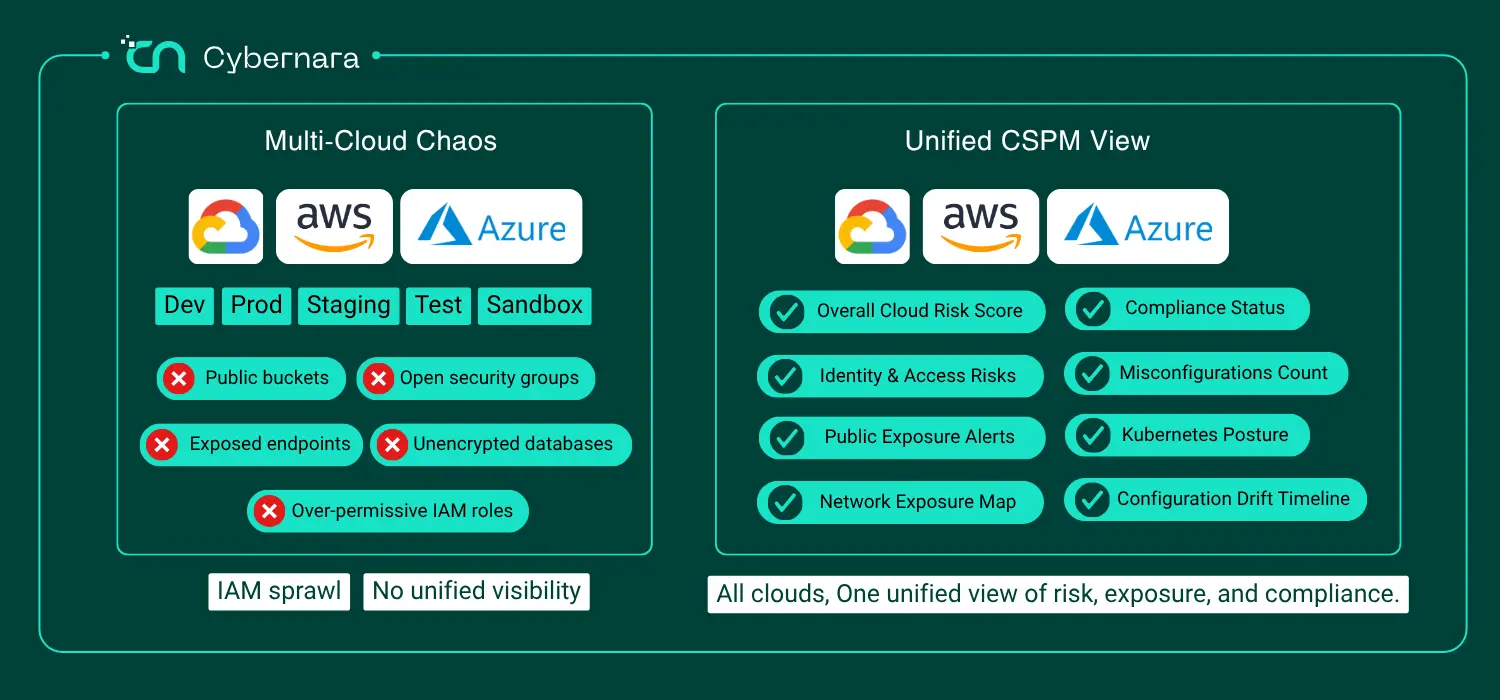
Multi-Account, Multi-Cloud Chaos: Why Dashboards Aren’t Enough For Australian Companies
As organizations grew, their cloud environments expanded. One AWS account became ten. Azure was added for a partner project.
GCP was adopted by a data science team. Before long, every department had its own cloud space, its own settings, its own exceptions, and its own way of deploying things.
What started as convenience slowly became chaos: hundreds of configurations scattered across platforms, none of which looked or behaved the same. On the surface, dashboards promised visibility, but all they really offered was a prettier way to be overwhelmed.
Every Cloud Spoke a Different Language
IAM in AWS wasn’t IAM in Azure. Storage permissions didn’t match across providers. Logging worked differently everywhere. A single security rule that made sense in one cloud needed to be rewritten, reinterpreted, and rechecked in the others.
Problems Hid Behind Aggregated Metrics
Dashboards showed “green”, “yellow”, and “red”, but not the quiet exposures behind them. A single misconfigured VPC peered with a forgotten subnet. A backup snapshot accidentally made public. A role with admin privileges created months ago and never removed. These details never showed up in graphs — only in breaches.
Teams Built Silos Without Meaning To
Cloud teams focused on the platforms they knew, solving problems within their own slice of the environment. No one noticed that a security gap fixed in one cloud remained wide open in another. Visibility existed — just not where it mattered.
Alerts Kept Coming, But Context Never Followed
Multi-cloud dashboards generated warnings faster than anyone could read them. What they didn’t explain was which system owned the resource, who created it, why it existed, or whether removing it would break production.
Fragmented Security Created Fragmented Risk
When every cloud is monitored separately, risk stops being a single picture. Instead, it becomes a puzzle — one where missing pieces matter more than the ones you can see.
The problem was believing that dashboards alone could make sense of cloud sprawl.
What CSPM Actually Watches in Your Cloud
Identity and Access Controls That Shape Your Entire Security
Misconfigurations That Create Silent Entry Points
Network Exposure That Opens the Door to Attackers
Data Stores That Should Never Be Public
Logging and Monitoring That Protect Visibility
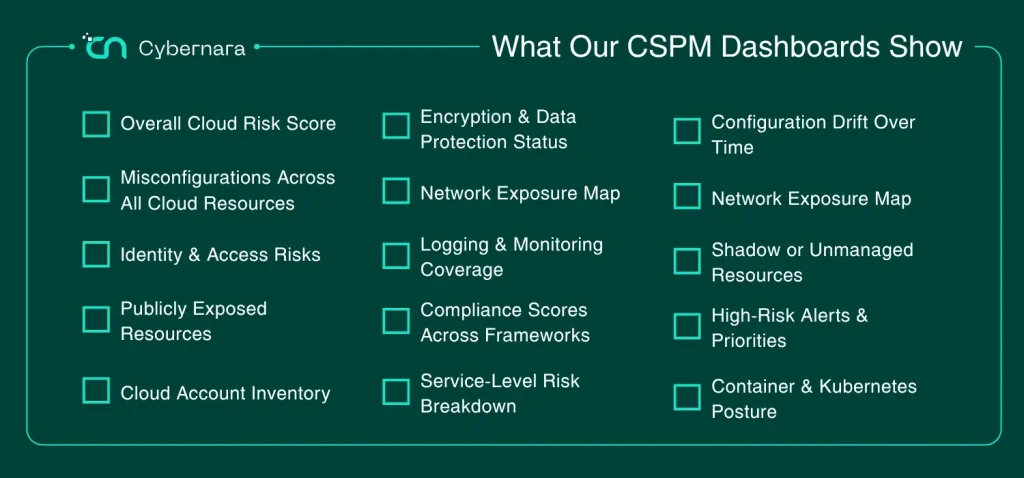
What Our CSPM Dashboards Show
This isn’t the full range of what our CSPM dashboards reveal — it’s only the surface. Behind the scenes, we monitor dozens of deeper signals across identities, networks, data, workloads, and compliance. Whatever your cloud environment needs, our CSPM expands to give you complete, continuous visibility.
Clients Who Trust Us







CSPM and Compliance: Making Audits Less Painful In Australia
Controls Stop Being Checklists and Become Living Settings
Evidence Collection Stops Feeling Like Excavation
Compliance Drift Gets Caught Before It Becomes a Violation
Temporary Exceptions Don’t Become Permanent Blind Spots
Audits Turn From Stress Events Into Simple Reviews
CSPM doesn’t just help you pass audits. It turns compliance into a predictable, steady rhythm instead of a frantic yearly scramble — replacing panic with clarity, and guesswork with real-time truth.
What You See as a Customer: Dashboards, Alerts, and Reports
Instead of scattered consoles and disconnected views, CSPM gives you a single screen that shows your overall risk score, exposed resources, identity weaknesses, and compliance status across all accounts and clouds.
You instantly know where you stand and what needs attention without digging through endless menus.
Alerts That Highlight What Actually Matters
You don’t get flooded with noise. CSPM prioritizes alerts based on impact: public databases, over-permissive IAM roles, disabled logging, encryption gaps, or internet-facing endpoints. Each alert comes with the context you need — what’s risky, why it matters, and what it could lead to if ignored.
Reports That Turn Technical Findings Into Clarity
CSPM automatically generates structured reports that break down misconfigurations, risks, compliance gaps, and improvement trends. They’re readable, visual, and built for decision-making — whether it’s for your internal leadership, an auditor, or your DevOps teams. No jargon, no guesswork, no hunting for evidence.
Trends That Show Whether You’re Improving
You can see how your risk posture changes week to week — misconfigurations decreasing, compliance scores improving, and exposure paths shrinking. CSPM turns cloud security into something measurable, so you can prove progress with data instead of opinions.
Insights That Help You Plan, Not React
Beyond findings, CSPM shows patterns: recurring issues, risky teams or workloads, and services that consistently drift out of configuration. These insights help you shape real strategy — policy updates, training needs, or governance improvements — instead of fighting the same fires again and again.
CSPM shows you the story of your cloud, clearly, continuously, and in a way your entire team can understand and act on.
Services Our Clients Trust Us With
Protect Your Data, People & Business From Threat Attacks
Get Started With A Free Security Audit
FAQs
Do we still need our cloud security tools if we have CSPM?
Yes, CSPM doesn’t replace firewalls, WAFs, EDR, or CI/CD security tools.
It complements them by securing the foundation — identities, policies, networks, and storage. Think of it as the guardrail that keeps every cloud service configured correctly.
How much effort is required from our internal team to implement CSPM?
Very little. CSPM handles discovery, monitoring, and evidence collection automatically. Your teams only step in when something needs fixing — and even then, CSPM provides the exact guidance.
Can CSPM help with compliance for audits like ISO, SOC 2, or PCI?
Yes. CSPM continuously maps your cloud against these frameworks, highlights gaps, and provides ready-to-use evidence for auditors. It turns compliance from a yearly sprint into a daily habit.
Does CSPM work for multi-cloud environments?
Absolutely. Whether you use AWS, Azure, GCP, or all three, CSPM unifies everything into one view. You get consistent checks, consistent alerts, and consistent reporting across all platforms.