
Compliance Advisory (ISO 27001, GDPR, PDPL, SOC2, HIPAA, Essential 8) India
Where Compliance Pressure Really Comes From Today in India
Most companies don’t wake up one morning and decide to pursue ISO 27001 or SOC 2 out of passion. Compliance pressure builds slowly and comes from all sides at once. One customer asks for proof of security.
A regulator introduces new reporting rules. A cyber insurer tightens its requirements. A partner requests an audit letter. What starts as a small request turns into a long list of expectations no one was prepared for.
Customers Who Will Not Sign Without Proof
Buyers today expect more than a verbal assurance that their data is safe. They want certificates, reports, control lists, and documented processes. For many companies, a single missing certification can block a six figure deal.
Regulators That Keep Adding New Rules
Whether it is GDPR in Europe, PDPL in the Middle East, HIPAA in healthcare, or Essential 8 in Australia, regulations evolve faster than internal processes do. Each change adds new requirements that demand documented controls and evidence.
Cyber Insurance Providers Raising the Bar
Insurers now ask for MFA, risk assessments, incident response plans, backup testing, and proof that controls are enforced. Without this, premiums rise or coverage gets denied entirely.
Vendors and Partners That Want Assurance Before Integrating
If your systems connect to theirs, they want proof that your environment will not become their risk. Many supply chain breaches pushed organizations to demand compliance from every partner, not just the big ones.
Internal Leadership Needing Visibility and Accountability
Boards and executives want clarity on risk, exposure, and preparedness. Compliance frameworks give them a structured way to measure security instead of guessing.
Market Expectations That Have Shifted Completely
Ten years ago, certifications were nice to have. Today, they are the minimum bar for entering global markets, especially in SaaS, fintech, healthcare, and cloud-based businesses.
Compliance pressure is no longer driven by a single authority. It comes from an ecosystem that expects proof, structure, and accountability. Modern businesses do not pursue compliance because it is trendy. They pursue it because everyone around them demands it.
What Happens When Compliance Is Treated As Just Paperwork
Policies That No One Follows
Controls That Only Exist During Audit Season
Evidence That Is Scrambled Together At The Last Minute
Teams That Treat Compliance As Someone Else’s Job
Audits That Become Stressful Instead Of Predictable
A False Sense Of Security At Leadership Level
Compliance only works when it reflects real behavior, real controls, and real evidence. When it turns into paperwork, it stops helping the business and starts hiding the very risks it was meant to reveal.
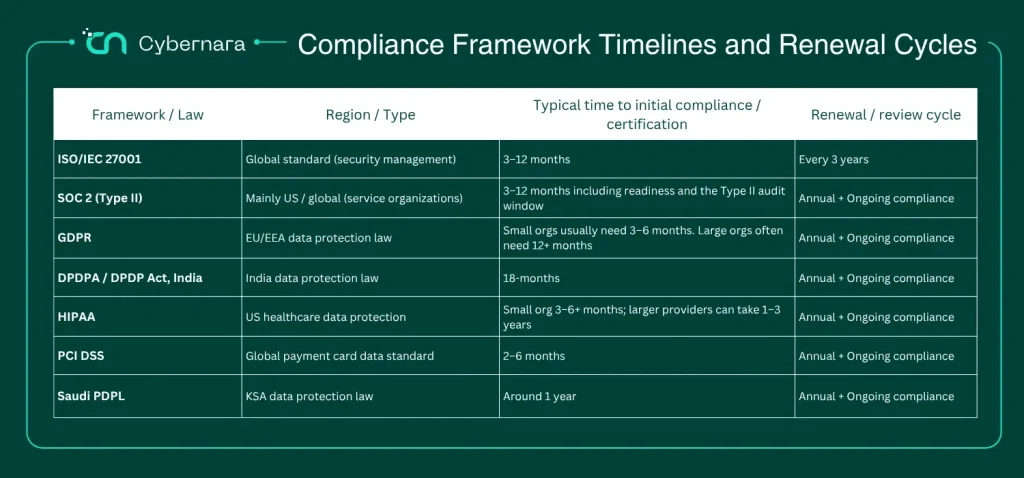
Compliance Framework Timelines and Renewal Cycles
Different frameworks move at different speeds. Some, like ISO 27001 and SOC 2, follow formal audit cycles, while others—like GDPR and DPDPA—require continuous operational readiness. This chart shows the typical timelines organizations face when working toward compliance.
Clients Who Trust Us







Translating Your Reality Into ISO 27001, SOC 2, HIPAA, GDPR, PDPL, and Essential 8 For Indian Companies
Turning Everyday Practices Into Valid Controls
Making Frameworks Fit Your Business Structure
Building Evidence Paths That Match How You Work
Aligning Teams Without Forcing New Tools
Explaining Requirements In Plain Language Your Teams Understand
Filling Gaps With Practical, Business-Friendly Controls
What Auditors Actually Look For And How We Prepare You For Them
Auditors are not trying to trick you or catch you off guard. They are looking for clarity, consistency, and proof that your controls actually work the way you say they do. Most businesses run into trouble not because their security is weak, but because their evidence is scattered, their ownership is unclear, and their processes are not documented in a way auditors can follow.
Preparing for an audit is really about telling a clear, structured story of how your organization protects data.
Controls That Exist In Both Documents And Reality
Auditors compare written policies with what teams actually do. If your documented steps and real workflows do not match, the control fails instantly. We align both sides so everything is consistent.
Evidence That Proves Controls Are Operating
Approvals, logs, screenshots, change tickets, reviews, and reports are the backbone of every audit. We prepare these evidence paths in advance so nothing becomes a last minute scramble.
Ownership Of Every Control
Auditors want to know who is responsible for each requirement. Not a department. A person. We help assign clear owners so there is no confusion during walkthroughs or interviews.
Processes That Are Repeatable And Not One Time Fixes
Auditors check if controls operate continuously. A single access review or backup test is not enough. We help you build routines that repeat on a schedule and leave behind traceable records.
Risk Thinking That Is Real And Not Template Driven
Auditors expect your risk register to reflect your environment, not a generic list from the internet. We help translate your actual threats, technologies, and business processes into meaningful risk statements.
Clarity In How Data Moves Through Your Business
For GDPR, PDPL, and HIPAA, auditors care deeply about data flow, retention, access, and storage. We map your real data lifecycle so privacy controls match what actually happens.
Walkthroughs That Tell A Clean Story
When auditors interview your team about change management, access control, incident response, or vendor reviews, the answers need to match documented processes. We coach teams so they speak confidently and consistently.
Audits go smoothly when everything lines up. Policies match operations. Evidence proves controls. Owners know their roles. Risks make sense. And the story your organization tells is the same in documents, tools, and practice. That is the preparation that turns audits from stressful to predictable.
Services Our Clients Trust Us With
Protect Your Data, People & Business From Threat Attacks
Get Started With A Free Security Audit
FAQs
How long does it take to become compliant with a framework like ISO 27001 or SOC 2
Most organizations takes six to twelve months depending on size, maturity, and how many controls already exist. The timeline gets shorter when evidence is already part of daily workflows instead of created from scratch.
Who collects the evidence required for audits?
We build clear evidence paths and help your teams collect them as part of their normal work. Approvals, logs, screenshots, tickets, and workflows become automatic evidence instead of manual tasks.
Can we fail an audit?
Yes, but audits are predictable when preparation is realistic. Most failures happen because documented controls do not match real practices. Our job is to align both so nothing breaks during the audit.
Which framework should we start with?
It depends on your customers, your industry, and your market. SaaS companies usually start with SOC 2. Global businesses choose ISO 27001. Healthcare leans toward HIPAA. Privacy focused markets require GDPR or PDPL. We help you choose the framework that opens the most doors.