
Cybersecurity Policy Development Australia
The Gap Between Written Policies and Real Behavior
Most organizations suffer from a lack of alignment between what the policy says and what people actually do. This gap comes from busy teams, unclear rules, outdated documents, and workflows that evolved faster than the policy library ever did. Almost every breach, audit failure, or internal incident eventually comes back to this mismatch.
Below are the places where this gap quietly grows inside otherwise well-run companies.
Policies Written for Auditors, Not Employees
Many policies are drafted with formal language, legal phrasing, and compliance checklists. They read well on paper but make no sense to the engineers, analysts, or business teams who have to follow them. When people can’t understand a rule, they create their own version of it.
Rules That Don’t Match How Work Actually Gets Done
A policy may say “All changes require approval,” while DevOps teams deploy dozens of updates a day. A policy may say “No personal devices,” while half the sales team works from their phones. When policies ignore operational reality, shortcuts become the default path.
Roles and Responsibilities That No One Has Time For
Policies often assign responsibilities to teams who don’t have the bandwidth or the technical ability to execute them. Access reviews, evidence collection, backup validation, vendor risk checks — these fall into the cracks when ownership isn’t matched with capacity.
Tools That Don’t Enforce the Rules Automatically
If MFA is required by policy but optional in the system, people skip it. If logs “must be collected” but no one configured the SIEM, nothing gets captured. A written rule without technical enforcement is just an idea.
Policies That Become Stale While the Business Keeps Moving
New SaaS tools, AI platforms, remote workers, vendors, integrations — all appear faster than yearly policy reviews can update the rules. The environment evolves weekly; policies evolve yearly. That mismatch creates instant gaps.
Training That Exists Once a Year Instead of Every Day
People do not remember long PPT sessions. They remember simple reminders at the moment of action: a prompt during login, a checklist before onboarding, a warning before sharing data. Without reinforcement, policies fade from memory and old habits return.
The gap between written policies and real behavior is where most risk lives. Closing that gap requires policies that speak clearly, match daily workflows, and are reinforced by tools, evidence, and habits — not just documents.
Who Owns What: Governance, Roles, and Decision Rights
Executive Ownership: Who Sets the Direction
Security Governance: Who Designs the Rules and Oversees Compliance
Control Owners: Who Runs the Day-to-Day Work Behind Each Policy
Process Owners: Who Maintains the Operational Workflow
Decision Makers: Who Says “Yes,” “No,” or “Approved with Conditions”
Evidence Keepers: Who Maintains the Audit Trail
Review Owners: Who Ensures Policies Stay Current
Governance is the backbone of Cybersecurity Policy Development. When responsibility is explicit instead of assumed, policies stop being theoretical documents and become living rules that teams follow, tools enforce, and auditors can verify.
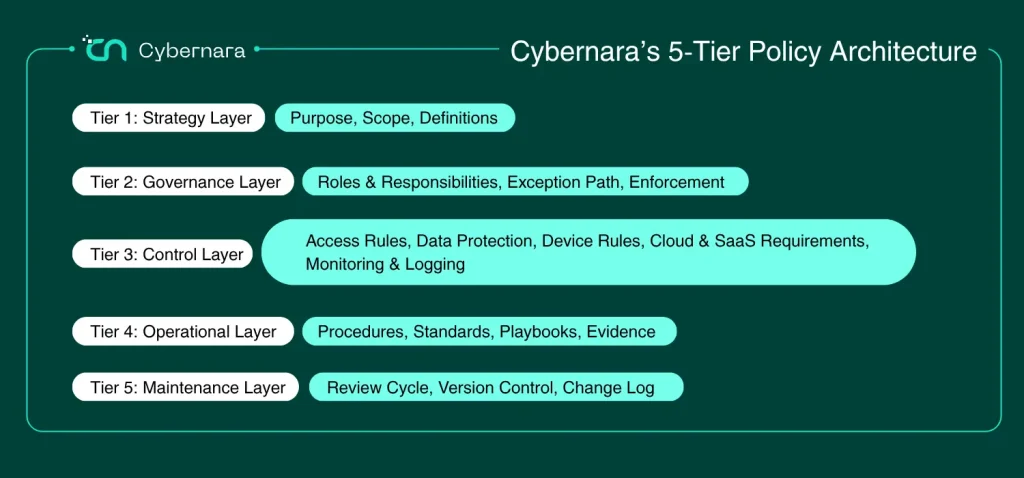
Cybernara’s 5-Tier Policy Architecture For Australian Businesses
A strong cybersecurity policy is never a single document — it’s an architecture. Our five layers show how purpose, governance, controls, operations, and maintenance work together to shape real-world security behavior. When each layer reinforces the others, policies stop being paperwork and become the foundation of how the organization actually works.
Clients Who Trust Us







What a Good Cybersecurity Policy Looks Like In Australia
Written in Plain Language Anyone Can Understand
Tied Directly to Daily Workflows
Supported by Actual Controls and Tools
Clear About Roles, Approvals, and Boundaries
Evidence-Driven and Audit-Ready
Flexible Enough to Handle Exceptions Safely
Updated Regularly as the Business Evolves
Keeping Policies Alive: Review Cycles, Exceptions, and Version Control
Cybersecurity policies fail because they were written badly — they fail because they were written once. A policy that made perfect sense last year may not fit today’s cloud stack, new vendors, remote teams, or AI tools.
Keeping policies alive is the work of treating them like living documents that evolve with the business, not static PDFs stored on a drive.
Below are the mechanisms that keep policies relevant, usable, and defensible.
Review Cycles That Match How Fast Your Business Changes
Not every policy ages at the same speed. Data retention or backup policies may stay stable for years, while cloud, identity, AI, and vendor policies can break within months. Good governance sets review cycles based on risk: quarterly for fast-moving areas, annual for stable ones, and immediate review after major incidents or system changes.
Handling Exceptions Without Turning Them Into the Real Policy
Every organization makes exceptions — that’s normal. But exceptions must be controlled. A good policy framework requires documenting the reason, approving it with conditions, assigning an owner, and setting an expiration date. When exceptions are tracked, they stay temporary. When they’re informal, they silently replace the policy itself.
Version Control That Shows the Evolution of Your Security Story
Policies need version numbers, change logs, and clear dates for when each version became active. This allows teams, auditors, and regulators to understand what rules existed at what time. It also prevents confusion when teams reference outdated PDFs or rely on rules that no longer apply.
Trigger-Based Updates for High-Risk Changes
Some updates shouldn’t wait for the next review cycle. New SaaS platforms, vendor breaches, technology migrations, org restructuring, or security incidents should automatically trigger a policy update. If the business changes, the rulebook must change with it.
Keeping policies alive is what turns cybersecurity from a static exercise into an ongoing practice. When review cycles, exceptions, and version control work together, policies stay current, teams stay informed, and the business stays protected through every stage of change.
Services Our Clients Trust Us With
Protect Your Data, People & Business From Threat Attacks
Get Started With A Free Security Audit
FAQs
How many policies does a typical organization actually need?
Most businesses need 12–16 core policies covering identity, access, data, vendors, incidents, and baseline security. The exact set depends on your tech stack, risk level, and industry requirements.
What’s the difference between a policy, a standard, and a procedure?
A policy sets the rule. A standard defines the minimum technical requirements. A procedure explains how people follow it step by step. You need all three for clarity and consistency.
How often should our policies be reviewed?
At least annually, but faster-moving areas like cloud, AI, identity, and third-party access need quarterly reviews. Major incidents or technology changes should trigger immediate updates.
What if our teams don’t follow the policy after it’s written?
Then the policy needs simplification, better training, or technical enforcement. We help you align policy and behavior by updating workflows, automating controls, and making rules easy to follow.