
Cybersecurity Staff Augmentation (L1–L3 engineers, SOC, cloud, IAM specialists) India
L1, L2, L3: What Each Level Actually Does and Why It Matters In India
Security operations look chaotic from the outside — alerts firing, logs pouring in, suspicious activity requiring judgement, and incidents demanding fast escalation. But behind that chaos is a layered system.
L1, L2, and L3 engineers each play a different role in keeping threats contained, alerts under control, and your environment continuously monitored. When these levels work in sync, your security program feels stable and predictable. When they don’t, everything feels noisy, slow, and reactive.
L1 – The First Line of Defense (Triage & Quick Response)
L1 engineers monitor dashboards, acknowledge alerts, perform initial triage, and handle routine investigations. They separate false positives from legitimate threats and escalate only what truly needs deeper analysis.
L2 – The Investigators (Deep Analysis & Containment)
L2 engineers dig into suspicious activity, correlate logs, review indicators of compromise, and handle mid-complexity incidents. They take ownership of cases L1 cannot close and work toward containment.
L3 – The Specialists (Root Cause & Complex Fixes)
L3 engineers bring deep expertise — cloud, IAM, network security, malware reverse engineering, or advanced detection logic. They solve complex incidents, tune SIEM/EDR rules, and create long-term fixes that prevent repeat problems.
Why This Layering Matters for Your Business
Without L1, your senior engineers drown in noise. Without L2, threats get stuck in limbo. Without L3, problems repeat because no one fixes the root cause. Each level exists so issues flow smoothly, escalation paths stay clear, and incidents are resolved quickly instead of endlessly bouncing between teams.
When You Should Augment — and When You Should Build In-House
Augment When You Need Skills Faster Than You Can Hire
Augment When Your Team Is Overloaded or Burned Out
Augment When You Have Compliance Deadlines Approaching
Build In-House When Security Is Core to Your Product or Industry
Build In-House When You’re Large Enough for Dedicated Teams
Staff augmentation is perfect when you need speed, skills, and flexibility. In-house teams make sense when security becomes a long-term strategic anchor. The real power comes from knowing exactly which moment you’re in and choosing the model that matches it.
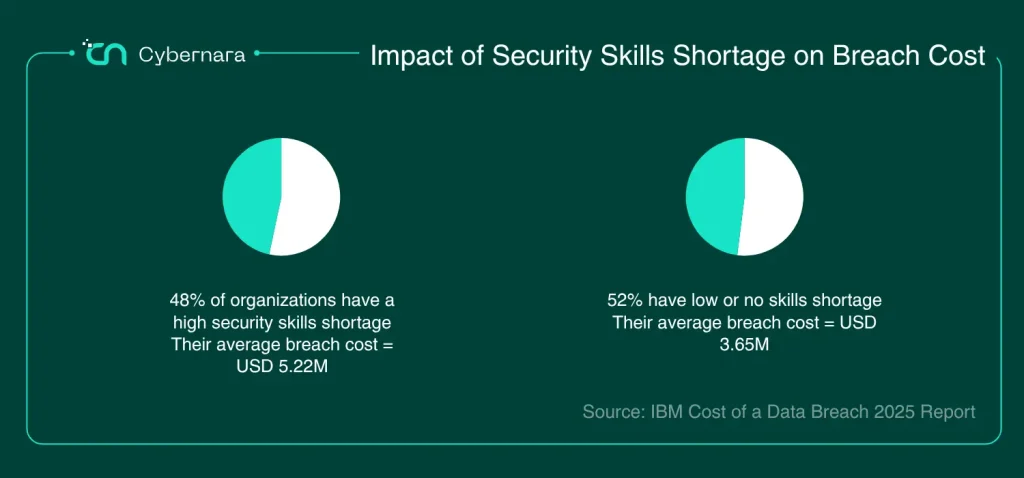
Impact of Security Skills Shortage on Breach Cost
Organizations facing a high security-skills shortage suffer significantly higher breach costs — USD 5.22M compared to USD 3.65M for those with stronger security teams. This gap shows how missing L1–L3 engineers, SOC analysts, cloud, and IAM specialists directly increases financial risk. Staff augmentation bridges that shortage quickly, helping you move from the “high-cost” group into the “lower-risk, lower-impact” group.
Clients Who Trust Us







Global Coverage Without Building a 24×7 Team From Scratch For Teams In India
Support Without Multiple Offices
Night, Weekend, and Holiday Coverage Included
Seamless Handoffs Between Time Zones
Better Alert Quality Because Analysts Stay Fresh
Coverage Scales Instantly When Alert Volume Spikes
No Infrastructure, HR, or Management Overhead
What Cybernara Measures: SLAs, MTTR, Ticket Quality, and Real Security Outcomes
Security teams don’t fail because they lack tools — they fail because they can’t prove whether the work they’re doing actually makes the environment safer. That’s why our augmentation model isn’t just “extra hands.”
We measure everything that matters to your security program, from response times to investigation quality, escalation accuracy, and long-term risk reduction. These metrics turn daily operations into predictable, repeatable, and trackable security performance.
SLAs That Keep Work Moving at the Right Speed
We commit to response and resolution times that match your internal expectations — ensuring alerts, tickets, and incidents don’t sit idle or stalled.
MTTR: How Fast We Contain and Resolve Incidents
Mean Time to Respond and Mean Time to Resolve give you a clear view of how quickly threats are handled — and where processes can be tightened.
Ticket & Investigation Quality Checks
Every analyst’s work is reviewed against playbooks, evidence quality, escalation criteria, and communication clarity — so you get depth, not checkbox responses.
Alert Accuracy: Reducing Noise Instead of Drowning in It
We track false positives, missed detections, improper escalations, and tuning opportunities — helping your SIEM/EDR get smarter over time.
Root-Cause Visibility, Not Just Surface Fixes
We measure how often recurring issues actually get eliminated, not just closed. This shows whether your security posture is improving or stagnating.
Coverage & Consistency Across Time Zones
Handover quality, shift coverage, and investigation continuity are tracked to ensure global operations feel seamless — not fragmented.
Good security isn’t measured by the number of alerts closed — it’s measured by how much safer you are month after month. Cybernara gives you the metrics that actually prove progress, not just activity.
Services Our Clients Trust Us With
Protect Your Data, People & Business From Threat Attacks
Get Started With A Free Security Audit
FAQs
How fast can Cybernara deploy L1–L3 engineers or specialists?
Most roles are filled within 5–10 business days. We maintain a pre-vetted bench of SOC analysts, cloud security engineers, IAM specialists, and incident responders ready to plug into your environment.
Do augmented engineers work inside our tools and processes?
Yes. They use your SIEM, EDR, ticketing system, change management flow, and communication channels. The goal is to blend into your team — not create a parallel one.
How do you maintain the quality of augmented staff?
Through playbooks, continuous review, escalation checks, performance dashboards, knowledge sharing, and shadowing. Quality is monitored end-to-end.