
DevSecOps & Secure DevOps Integration UAE
Top Causes of Security Failures in DevOps Pipelines
Even the most advanced pipelines can collapse under small oversights. Security gaps rarely come from a single breach point: they emerge where speed, automation, and human judgment intersect.
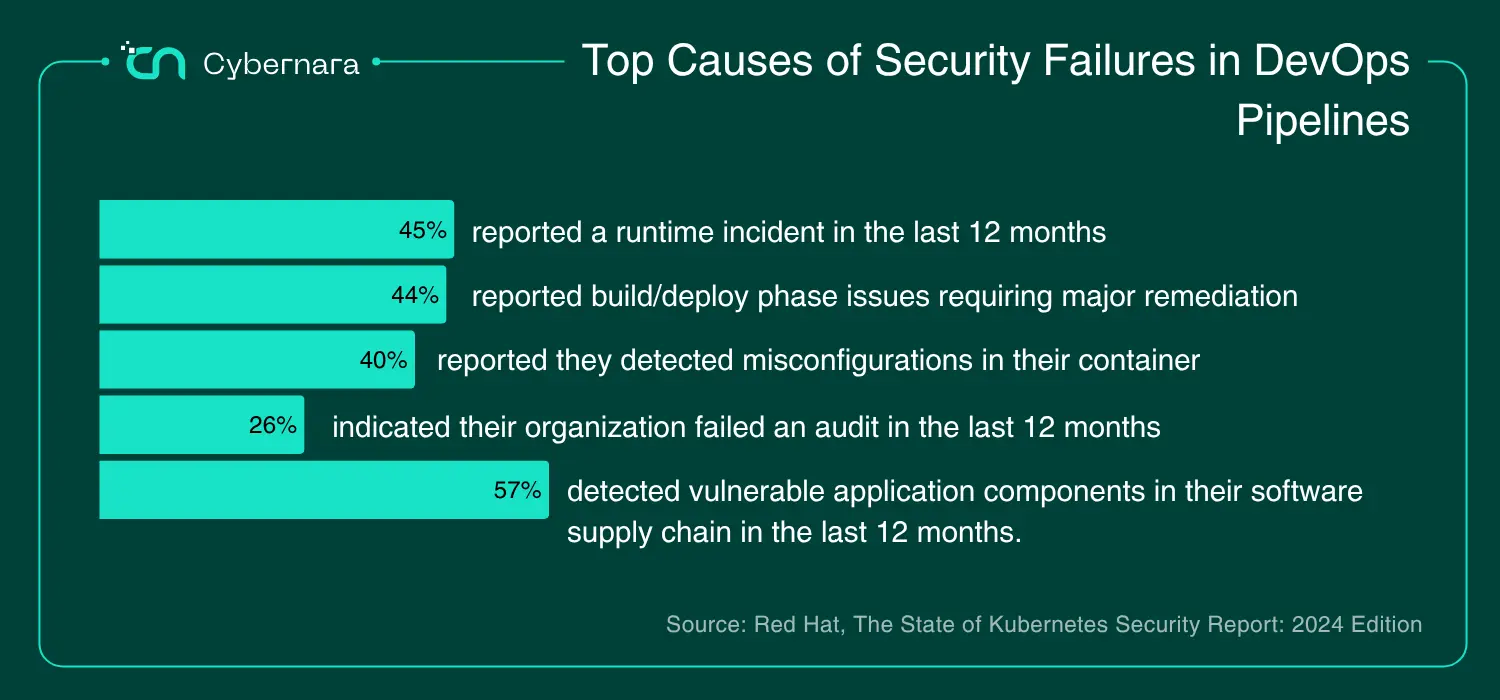
Where Things Usually Go Wrong
DevSecOps failures don’t come from bad intentions, they come from blind spots between speed, process, and shared responsibility.
Here’s what most assessments reveal when DevSecOps doesn’t deliver what it promises:
Late-Stage Security
Security checks that happen after the build, not within it.
By the time vulnerabilities surface, release deadlines take priority over remediation.
Speed wins; safety loses.
Siloed Teams, Scattered Goals
Developers, operations, and security work in parallel lanes with different metrics.
No one owns the whole picture — only fragments of it.
Gaps widen where communication ends.
Tool Overload, Process Undersight
Stacks of scanners, monitors, and dashboards — but no single accountable workflow.
Tools multiply faster than the ability to interpret or act on their findings.
Automation without alignment creates noise, not insight.
Manual Gates in Automated Pipelines
Approvals, policy checks, and compliance reviews still run by hand.
Continuous integration slows to a crawl when manual interventions break the rhythm.
Developers skip steps to keep builds moving.
Weak Secure Coding Practices
Applications built by skilled developers — but without security context.
Hard-coded credentials, poor input validation, and fragile session handling persist.
The code runs fine until someone malicious finds the same logic gaps.
Misconfigured Pipelines and Cloud Roles
CI/CD servers, secrets vaults, and container registries with excessive permissions.
One leaked credential or open endpoint can cascade through the environment.
Breaches often begin where automation meets misconfiguration.
No Post-Deployment Vigilance
Monitoring stops at “deployment complete.”
Without runtime detection, zero-days and API abuses go unseen.
Security ends where observability should begin.
Culture Without Continuity
DevSecOps seen as a project, not a principle.
Once dashboards stabilize, attention drifts.
Without continuous ownership, security maturity fades back to old habits.
How We Integrate DevOps Securely For Our UAE Clients
Security Built Into Code, Not Bolted On Later
Automated Scans in Every Pipeline Stage
Automated Scans in Every Pipeline Stage
Policy-as-Code and Guardrails
Container and Cloud Hygiene
Secrets and Identity Protection
Continuous Monitoring and Runtime Protection
Findings don’t just go into reports — they come back as learning. We train teams to interpret results, fix root causes, and code securely without friction. The goal: developers who build with security instinctively, not reactively.
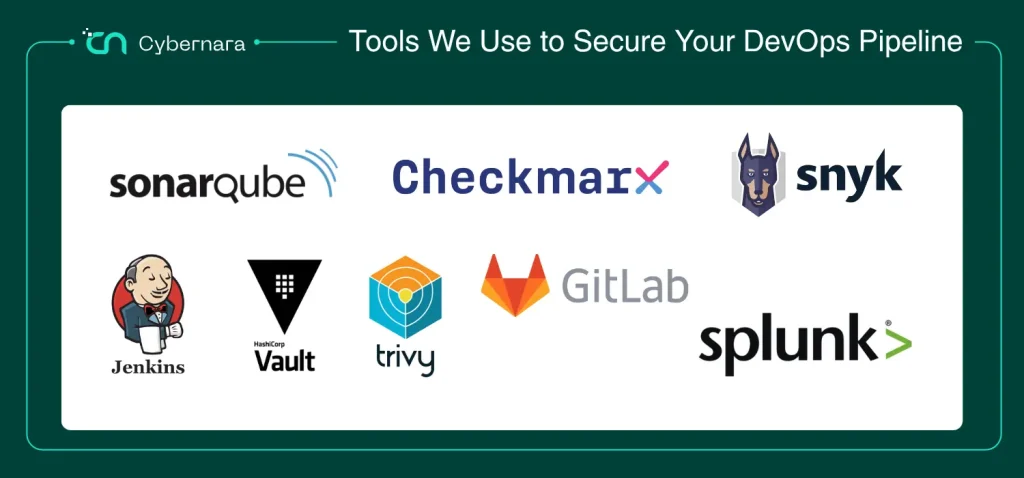
Tools We Use to Secure Your DevOps Pipeline
Our DevSecOps toolkit blends automation, intelligence, and transparency — ensuring every build is scanned, verified, and monitored. The tools shown here represent our core stack for code scanning, dependency management, secrets protection, and observability. Cybernara uses an even broader ecosystem of technologies and proprietary scripts to deliver complete, end-to-end security for your systems.
Clients Who Trust Us







Benefits of Integrating Security Early
Reduced Cost and Faster Fixes
Shorter Release Cycles
Fewer Incidents, Lower Risk Exposure
Stronger Compliance and Audit Readiness
Empowered and Collaborative Teams
Higher Customer Trust and Reputation
Metrics That Define a Successful DevSecOps Security in UAE
A mature DevSecOps program is measured by how effectively people, process, and technology prevent risk without slowing innovation.
These are the metrics that reveal whether your integration truly works:
Mean Time to Detect (MTTD) & Mean Time to Respond (MTTR)
How long it takes to identify and fix security issues once they appear.
Lower numbers mean faster awareness and tighter collaboration between security and development teams.
Best-in-class pipelines aim for hours, not days.
Vulnerability Remediation Rate
The percentage of known vulnerabilities fixed within a defined timeframe.
High-performing teams maintain a 90%+ remediation rate within 30 days (GitLab 2024).
Slow remediation signals bottlenecks in prioritization or tooling.
Percentage of Automated Security Tests in CI/CD
Automation is the backbone of DevSecOps maturity.
Track what portion of builds include SAST, DAST, IaC, or dependency scans automatically.
The closer this is to 100%, the fewer issues reach production unnoticed.
Secure Code Coverage
Measures how much of your application codebase is covered by security testing tools.
It’s not enough to scan frequently — you need to scan completely.
A gap in coverage is a blind spot waiting to be exploited.
Rate of Vulnerabilities Found Pre- vs. Post-Production
A healthy program finds most flaws before release.
Your goal: 80–90% of vulnerabilities discovered during development, not after deployment.
It’s the clearest indicator of “shift-left” effectiveness.
The ultimate test of DevSecOps maturity: how often critical vulnerabilities reach production.
A steady decline here signals a strong, evolving feedback loop between build and monitor stages.
Services Our Clients Trust Us With
Protect Your Data, People & Business From Threat Attacks
Get Started With A Free Security Audit
FAQs
How can Cybernara help us implement DevSecOps?
Cybernara builds and integrates end-to-end DevSecOps pipelines — from toolchain design and automation to cultural enablement. We focus on secure-by-default delivery, continuous compliance, and developer empowerment so that your security posture grows stronger with every sprint.
How long does it take to mature a DevSecOps practice?
It depends on your starting point.
Teams with established DevOps pipelines can typically begin embedding security automation in 3–6 months, while full cultural and process maturity may take a year or more.
What’s the biggest mistake companies make when adopting DevSecOps?
Treating it as a security project instead of a shared responsibility.
DevSecOps succeeds when developers, operations, and security teams collaborate continuously — not when it’s siloed under one function.
How does Cybernara help with DevSecOps integration?
Cybernara assesses your existing pipelines, identifies gaps, and integrates security controls that align with your delivery speed. From code scanning to compliance automation, we ensure your DevOps becomes truly secure — without slowing innovation.