
Managed Endpoint Detection & Response (EDR) UAE
Modern Attack Techniques AntiVirus Fails to Detect
Modern attacks don’t look like traditional malware anymore. They run in memory, abuse trusted tools, steal credentials, and blend into normal system activity — all things antivirus was never built to detect. EDR focuses on behavior, not files, catching the subtle signs of compromise long before an attacker becomes a breach.

Where Traditional Antivirus Falls Short
Traditional antivirus was built for a time when threats were loud, obvious, and predictable, for a world of infected files, known viruses, and attacks that followed familiar patterns.
But as threats evolved, the ground shifted beneath it. Attacks became quieter, smarter, and less dependent on the things antivirus knows how to catch. Over time, the old defenses stayed the same while the attacks changed their shape entirely.
Fileless Attacks Left Nothing to Scan
Malware no longer arrives as a file. It runs in memory, hides inside legitimate system processes, and slips past tools designed to inspect what no longer exists.
Everyday Tools Became Attack Vectors
PowerShell, WMI, RDP — tools meant for administration — turned into weapons. Their activity looks normal, so antivirus rarely sees the danger behind them.
Stolen Credentials Walked Through the Front Door
When attackers log in with valid usernames and passwords, antivirus has no reason to raise an alarm. To the system, nothing appears out of place.
Threats Evolved Faster Than Signatures Could
Signatures rely on what is already known. Modern threats rewrite themselves, change behaviors, and adapt before any signature is published.
Attacks Became Journeys, Not Events
Instead of a single malicious file, attacks now unfold as a chain of small, quiet steps — reconnaissance, privilege escalation, lateral movement — none of which look suspicious in isolation.
Traditional antivirus wasn’t defeated — the battlefield simply moved. It still guards the doors it was built for, but today’s attackers enter through places it was never designed to watch.
Why Endpoints Are the First Target in Most Attacks In UAE
People Interact With the World Through Their Devices
Credentials Sit Just a Click Away
Remote and Hybrid Work Removed the Old Boundaries
Endpoints Touch Every System That Matters
Attackers Use Endpoints to Learn Before They Strike
Endpoints are chosen because they are dynamic, mobile, and woven into everyday work. In the story of most breaches, the first chapter begins not in a server room, but on someone’s screen.
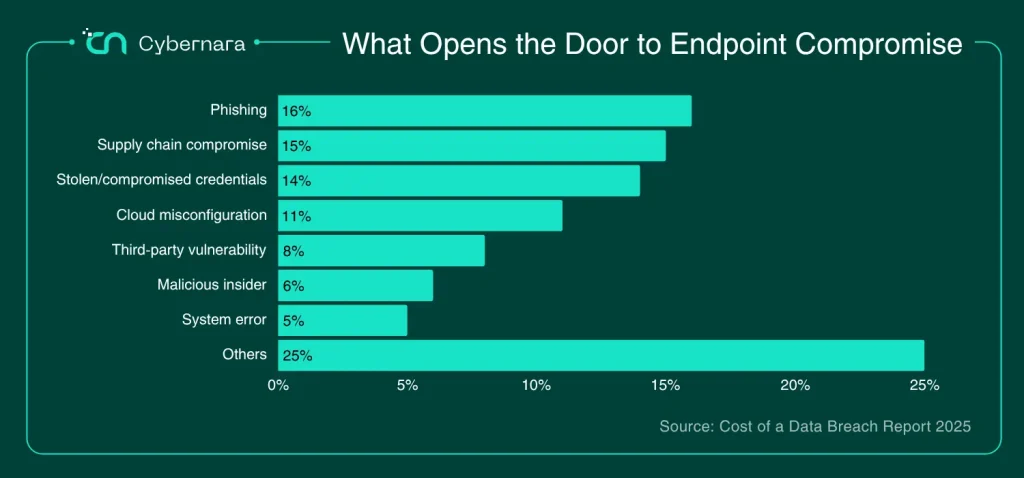
What Opens the Door to Endpoint Compromise
Most endpoint compromises start with simple entry points — a phishing email, a stolen credential, or a malicious update. These attacks trigger from user devices long before they become network-wide breaches. Understanding how attackers enter helps EDR detect the earliest signs of trouble and stop the incident before it spreads.
Clients Who Trust Us







What Our Managed EDR Bridges That Gap
Behavior-Based Detection That Sees What AV Misses
Human Analysts Close the Loop
Immediate Containment Before Damage Spreads
Root Cause and Recovery Built In
Managed EDR fills the modern security gap by detecting the subtle, behavioral signs of compromise and responding fast enough to stop attackers before they spread.
EDR Response Playbooks for UAE Companies: Contain, Isolate, Remediate
Every confirmed threat follows a clear, structured response path. No confusion. No delay. Each action is designed to stop the attacker’s momentum immediately and restore the device safely. The goal is simple — contain fast, isolate cleanly, and remediate fully.
Contain: Stop the Threat at Its Source
Containment begins the moment malicious behavior is verified.
Suspicious processes are killed, persistence mechanisms are removed, and command-and-control connections are cut off.
This shuts down the attacker’s ability to execute further actions or spread to other systems.
Isolate: Prevent Lateral Movement
If the device shows signs of deeper compromise, it’s isolated from the network instantly.
The user loses access to internal systems, but the EDR keeps a secure forensic tunnel open for analysis and cleanup.
Isolation ensures the attacker cannot move, scan, or pivot inside your environment.
Remediate: Clean, Restore, and Close the Entry Point
After containment, the device is cleaned — artifacts removed, malicious files deleted, registry or system changes reversed.
If supported, rollback brings the system back to a known-good state.
Credentials are rotated, vulnerabilities patched, and the root cause is addressed to prevent recurrence.
EDR playbooks ensure that every step — from detection to recovery — is fast, consistent, and reliable, giving attackers no chance to regain a foothold.
Services Our Clients Trust Us With
Protect Your Data, People & Business From Threat Attacks
Get Started With A Free Security Audit
FAQs
Do I still need EDR if I already have antivirus?
Yes. Antivirus looks for known malware. Modern attacks don’t use it. EDR catches the behavior — fileless execution, script abuse, credential theft — long before traditional tools notice anything.
Will EDR slow down my devices?
No. Modern EDR is lightweight. It lives quietly on the endpoint, analyzing behavior without interrupting everyday work. Most users don’t even know it’s running.
How does EDR differ from XDR?
EDR focuses on endpoint behavior. XDR connects signals across endpoints, cloud, identities, email, and network. EDR is the foundation — XDR is the expansion.
What happens when a real threat is detected?
The playbook kicks in instantly. The device is isolated, the malicious process is stopped, and our team begins root-cause analysis. You stay informed at every step.
Can EDR stop ransomware before it spreads?
Yes. EDR detects the early moves — unusual encryption activity, shadow copy deletion, privilege escalation — and cuts the attack off before it reaches servers.