
Regulatory Audits & Support UAE
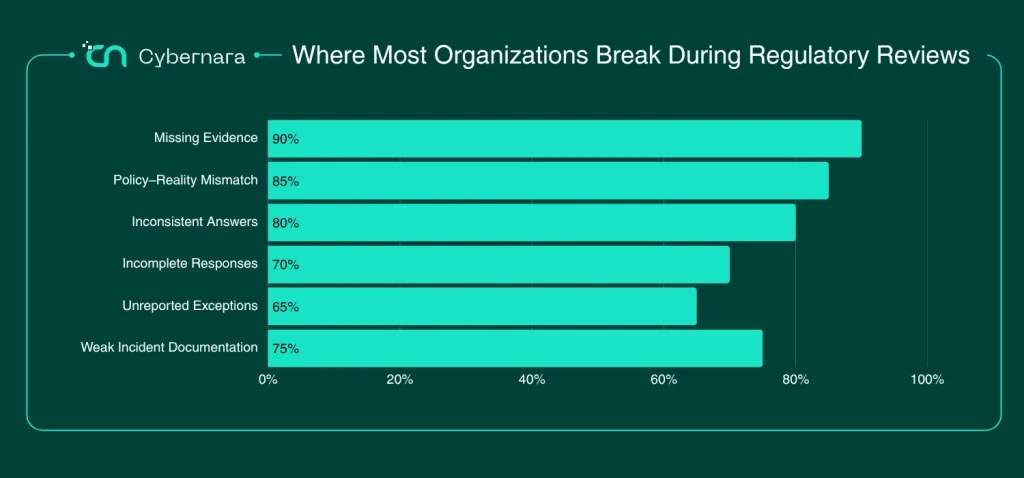
Where Most Organizations Break During Regulatory Reviews
Most organizations do not fail regulatory reviews because of weak security tools. They fail because the story behind their controls is inconsistent, incomplete, or impossible to prove. This chart highlights the everyday operational gaps regulators notice first and why preparation matters long before an audit begins.
What Questions Regulators Ask In UAE
Regulators do not walk in with trick questions. They walk in with curiosity about how your organization really works behind the documents and dashboards.
Their focus is simple. They want to understand how you make decisions, how you control access, how you protect data, and how you respond when things go wrong. Most questions sound straightforward, but they reveal whether your policies match your actual practices.
Who Has Access And Why
Regulators want to know who can access sensitive systems and data, how that access was approved, and whether anyone reviews it regularly. They look for clean ownership and a clear understanding of why each person needs what they have.
What Data You Collect And Where It Moves
They ask how personal or sensitive data enters your systems, where it is stored, who can touch it, and how long you keep it. If there is no consistent data flow story, gaps appear instantly.
How You Detect And Respond To Incidents
They want to see if you have a real process for discovering security issues, investigating them, containing harm, and notifying affected parties. They look for evidence, not just a policy.
How Changes Are Made To Systems And Applications
Regulators ask who approves changes, how changes are recorded, and whether testing is done before updates go live. Uncontrolled changes are a major red flag.
How Vendors Are Chosen And Monitored
They ask whether you review third parties, check their security posture, and track the data you share with them. Supply chain risk is a common trigger for deeper questioning.
How You Train Your Employees
They want to know if teams are trained on security, privacy, data handling, and incident reporting. Training that only exists on paper creates immediate risk findings.
How Policies And Controls Are Enforced In Real Life
Regulators compare what you say in documents with what your teams actually do. If the two stories do not match, the control is considered weak or ineffective.
Regulators are not looking for perfection. They are looking for honesty, clarity, consistency, and proof that your business takes responsibility for the data it holds. The questions are simple, but the story behind them must be real.
Where Most Organizations Break During Regulatory Reviews
Policies That Do Not Match Reality
Data Flows No One Can Clearly Explain
Evidence That Is Scattered Across Tools And People
Access Rights That Were Never Cleaned Up
Incident Response That Exists Only In Theory
Vendor Risks That Were Never Reviewed
Changes Made Informally And Without Records
Organizations rarely fail regulatory reviews because of one big issue. They fail because the small foundations were never aligned. When controls, evidence, and behavior tell different stories, regulators see the cracks immediately.
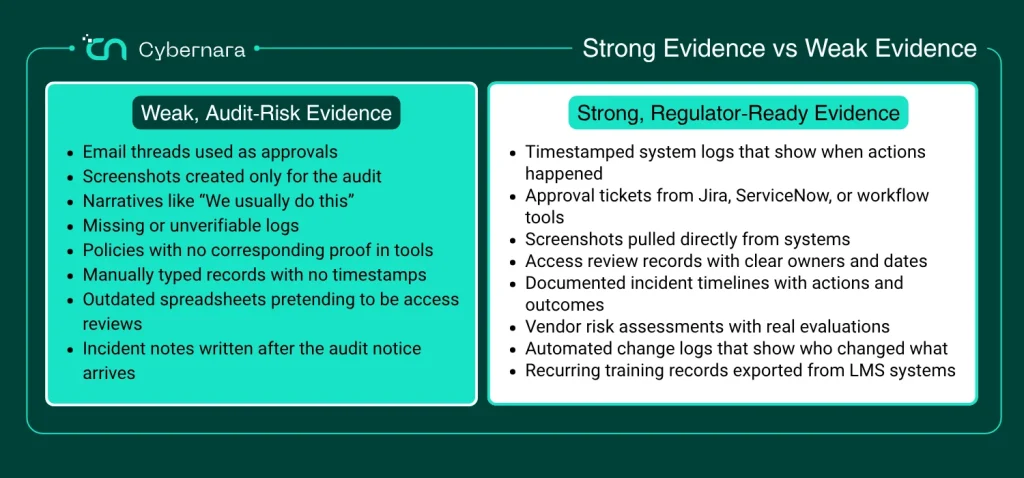
Strong Evidence vs Weak Evidence
Good evidence proves how your controls work in real life, not just how they look on paper. Regulators trust records that are timestamped, traceable, and system generated. Anything improvised during the audit raises red flags immediately.
Clients Who Trust Us







Where Cybernara Stands Beside You During Regulatory Audits
Preparing You Before The Audit Even Begins
Managing Every Information Request
Coaching Your Teams For Regulator Interviews
Organizing Evidence So It Tells A Single Story
Handling Follow Up Questions Quickly And Correctly
Turning Findings Into Clear, Timed Remediation Plans
Keeping You Ready For Future Audits
Turning UAE Operations Into a Story a Regulator Can Follow
Regulators are not looking for perfect systems. They are looking for a clear, honest story of how your organization works.
If your processes, tools, policies, and evidence all point in the same direction, the regulator understands you. When they do not, the audit becomes harder, longer, and filled with questions that should have been easy to answer. Turning your operations into a story is about alignment, not performance.
Showing How Work Actually Moves Through Your Organization
From access approvals to change requests, from vendor onboarding to incident handling, regulators want to see the real journey. When each step leaves a trace in the same tools and follows the same rules, the story becomes easy to follow.
Connecting Policies To The Daily Behaviors Behind Them
A policy is just chapter one. Regulators want to see chapters two and three, where people act on those policies. Evidence of regular reviews, training, and approvals proves the story is alive.
Making Processes Consistent Across Teams And Tools
If one team uses Slack, another uses tickets, and another manages tasks in email, the story becomes fragmented. Regulators look for repeatable patterns that show your controls operate the same way every time.
Highlighting Why Decisions Were Made Not Just What Was Done
A regulator wants to understand your reasoning. Why a risk was accepted. Why a vendor was approved. Why access was given. When decisions are documented, the narrative becomes coherent instead of reactive.
Putting Evidence In A Sequence That Makes Sense
Logs, tickets, emails, approvals, and reports are the paragraphs of your operational story. When they are organized by time and purpose, regulators can follow the timeline without confusion.
Making Sure Every Control Has A Clear Beginning And End
Every control has an origin. Who owns it. When it runs. Where the proof lives. Regulators look for the complete arc. When controls leave no loose ends, the story feels complete.
Keeping The Story The Same In Documents, Tools, And People
Regulators compare what is written, what is stored, and what employees say. If all three align, your story is strong. If they do not, the whole narrative becomes uncertain.
A regulator is not judging you on how complex your environment is. They are judging how clearly you can explain it and how consistently you can prove it. When your operations form a story that makes sense from beginning to end, the audit becomes predictable, readable, and far less stressful.
Services Our Clients Trust Us With
Protect Your Data, People & Business From Threat Attacks
Get Started With A Free Security Audit
FAQs
What kind of evidence do regulators typically ask for?
They request real artifacts — logs, approvals, screenshots, change records, incident timelines, meeting minutes, vendor assessments, DPIAs, data maps, and access reviews. Policies alone are never enough.
How fast do we need to respond to regulators?
Deadlines vary by regulator, but responses usually need to be complete, accurate, and submitted within 7–30 days. Extensions may be possible, but only with justification and proactive communication.
Do regulatory audits result in fines immediately?
Not typically. Most reviews result in observations, remediation requirements, or corrective action plans. Fines usually occur only when regulators believe there was negligence, repeated issues, or willful non-compliance.
Do we need a dedicated team to handle regulatory audits
Not always. Many organizations rely on a small internal group and Cybernara for guidance, evidence organization, interview coaching, and remediation planning.