
Risk Assessment & Mitigation India
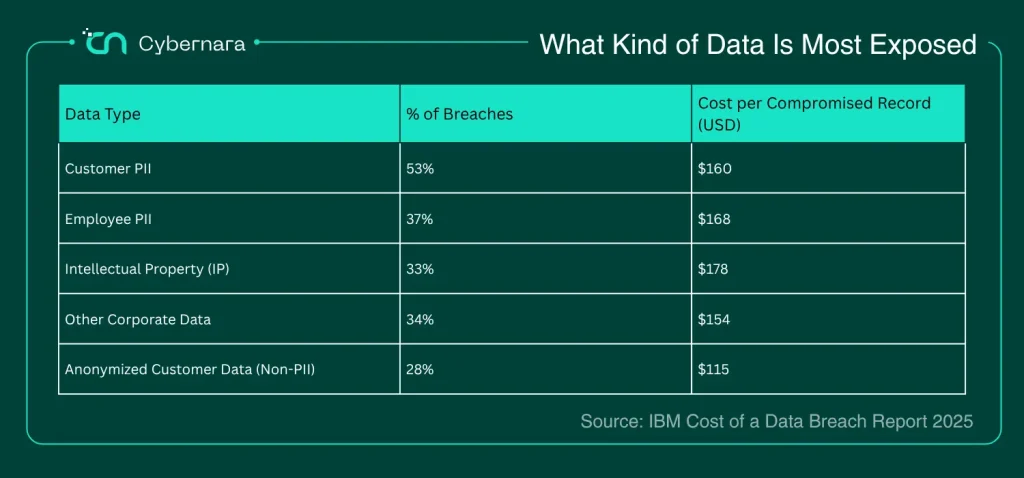
What Kind of Data Is Most Exposed
Not all data carries the same damage when exposed — and this chart makes that clear.
Customer and employee PII remain the most targeted and the most expensive to lose, while intellectual property and internal corporate data create deep operational damage when compromised. Knowing which data is at risk helps organizations focus mitigation where it protects the business the most.
Where Risk Really Hides in Indian Organizations
Risk in modern companies rarely announces itself. It doesn’t sit in a single firewall rule or one outdated server. It hides in the everyday decisions, shortcuts, assumptions, and blind spots that grow quietly over time.
Most risks are not technical at first — they start as small operational mismatches, unclear ownership, or habits that nobody questions until something breaks. Below are the places where risk usually hides, even in well-run teams.
Shadow IT No One Admits Exists
Teams sign up for tools, SaaS apps, or cloud services without security review. These systems handle data, store credentials, or integrate with core platforms — but no one tracks them. What starts as a quick workaround becomes an invisible attack surface.
Access Nobody Remembers Granting
Contractor accounts, old admin rights, privileged roles created “just for a week,” and shared passwords used for convenience. These forgotten access paths are among the most common sources of breaches — and the hardest to detect before something happens.
Data That Moves Without a Map
Customer information copied into spreadsheets, logs stored in unmanaged buckets, analytics tools exporting data automatically, or backups synced to external locations. When no one knows every place data travels, risk grows quietly behind the scenes.
Legacy Systems That Survive Because They Still ‘Work’
Old servers, outdated applications, unsupported operating systems, and forgotten internal tools that nobody wants to touch. They usually run critical workflows — and no one has patched them in years. Risk hides in the comfort of “we’ll replace it soon.”
Process Workarounds That Become Permanent
Teams bypass change approvals to release faster, skip documentation to save time, or fix issues manually instead of addressing the root cause. A workaround done once is normal. Done twice becomes a habit. Done ten times becomes a hidden risk.
Dependencies On Vendors You Assume Are Secure
Organizations trust vendors by default — without checking their security posture, breach history, or how they handle shared data. When a supplier is compromised, the impact travels directly into your environment.
Risk does not hide in one place. It hides in the gaps between people, tools, and processes — the areas where responsibility is assumed but never confirmed. Finding risk is not about discovering one big weakness; it is about uncovering the small inconsistencies that, over time, create openings attackers can use and regulators will question.
Turning Technical Findings into Business Language
Linking Vulnerabilities to Business Outcomes
Explaining Impact in Terms Leadership Already Uses
Clarifying How Likelihood Changes the Priority
Showing Cause and Effects
Connecting Technical Fixes to Operational Value
Visualizing Risk Instead of Describing It
Turning technical findings into business language bridges the gap between discovery and decision. It ensures that security insights travel beyond engineering teams and become strategic inputs for leadership — actionable, prioritized, and tied to the outcomes the business cares about most.
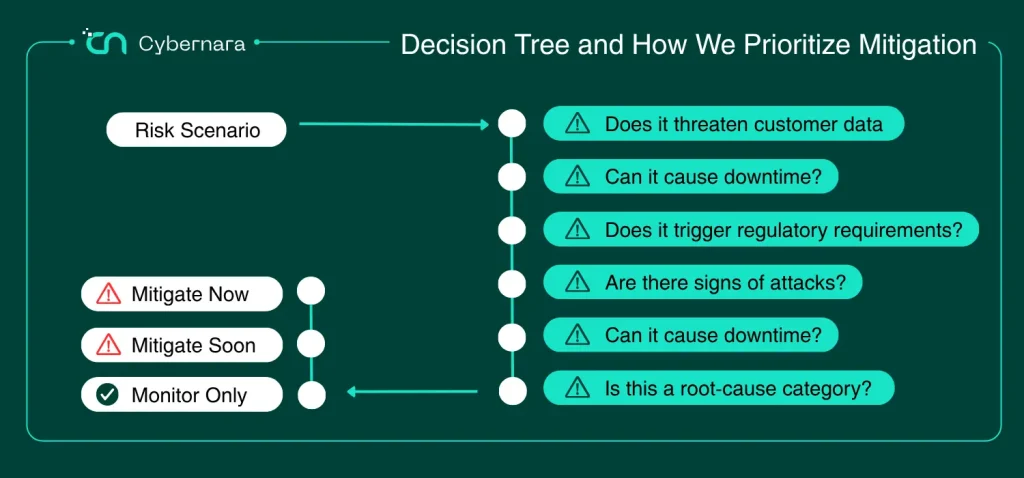
Decision Tree and How We Prioritize Mitigation
Decision-making in risk mitigation is structured clarity. This framework shows how we evaluate every risk scenario against real business impact: customer data, downtime, regulatory exposure, active threats, and root-cause patterns. When the questions are clear, the priorities reveal themselves — so mitigation becomes intentional, not reactive.
Clients Who Trust Us







Continuous Assessment vs One-a-Year Assessment
Annual Assessments Freeze the Past, Not the Present
Risks Change Faster Than Yearly Reviews Can Catch
Small Issues Become Big Gaps When Left Untouched for a Year
Regulators and Cyber Insurers Expect Ongoing Evidence
Annual Assessments Struggle With Business Changes
Choosing What to Mitigate First For India Specific Workspaces
Most organizations don’t struggle because they lack information. They struggle because they don’t know where to begin. A risk register can list dozens of issues — misconfigurations, access gaps, outdated systems, fragile workflows, missing controls — but not every risk deserves attention at the same time.
Choosing what to mitigate first is the moment where risk management stops being theoretical and becomes practical. It is the work of deciding which problems truly matter, which ones can wait, and which ones only look urgent on paper.
Understanding What Puts the Business at Immediate Risk
Some risks lead directly to data exposure, operational downtime, or regulatory trouble. These are not technical findings — they are business threats in disguise. Anything that can cause rapid damage, trigger legal obligations, or stop customers from being served rises to the top instantly.
Distinguishing High Severity From High Impact
A critical vulnerability does not always lead to a critical consequence. Similarly, a low-severity gap — like an overly privileged account or an unmonitored vendor — can cause massive damage if exploited. Mitigation starts by asking not “How bad is the issue?” but “How bad is the outcome?”
Understanding the Likelihood Behind the Numbers
Most risk scoring models blend likelihood and impact. But in real life, likelihood comes from patterns: repeated misconfigurations, recurring access drift, alerts ignored for months, or systems untouched for years. When evidence shows a risk is already inching toward failure, it moves to the front of the queue.
Prioritizing What Attackers Would Target First
Attackers go after the easiest paths: weak credentials, exposed web endpoints, public cloud misconfigurations, and trusted integrations. If the organization fixes the risks attackers are most likely to exploit, the overall attack surface shrinks dramatically. Prioritization becomes a matter of anticipating their next move.
Balancing Quick Wins With Long-Term Resilience
Some mitigations can be done in hours — removing unused admin accounts, closing unnecessary ports, forcing MFA. Others require deeper redesigns. A balanced plan includes both: fast actions that reduce exposure quickly and slower structural changes that improve resilience for years.
Choosing what to mitigate first is not about chasing severity scores. It is about understanding how your organization works, where it is vulnerable, and what would hurt the most if it failed tomorrow. The goal is simple: reduce the biggest risks with the least disruption, while building a safer foundation for everything that follows.
Services Our Clients Trust Us With
Protect Your Data, People & Business From Threat Attacks
Get Started With A Free Security Audit
FAQs
Does every identified risk need to be fixed immediately?
Some risks require urgent action, while others may be accepted, monitored, or scheduled for future mitigation. Risk assessment helps you separate “must fix now” from “fix when resources allow” and “safe to accept for now”.
How do we know which risks matter the most?
Prioritization comes from combining severity, likelihood, business impact, and how much exposure a weakness creates across other systems. This turns a long list of findings into a clear, logical order of what needs attention first.
What if we don’t have all the resources to fix everything?
If your internal team doesn’t have the time, bandwidth, or skillset to handle every priority, Cybernara provides the engineers, specialists, and support you need to close the gaps. We help you tackle the urgent fixes first, take ownership of the heavier technical work, and keep the mitigation plan moving without overloading your team.