
Secure MLOps Setup India
Top Causes of Security Failures in DevOps Pipelines
Security failures in DevOps often stem from overlooked fundamentals — weak access control, unmonitored APIs, or misconfigured environments. This chart highlights the most common vulnerabilities identified across modern pipelines, showing how each can cascade into broader exposure if left unchecked. By securing these weak points early, Cybernara ensures your DevOps foundation remains resilient and compliant.
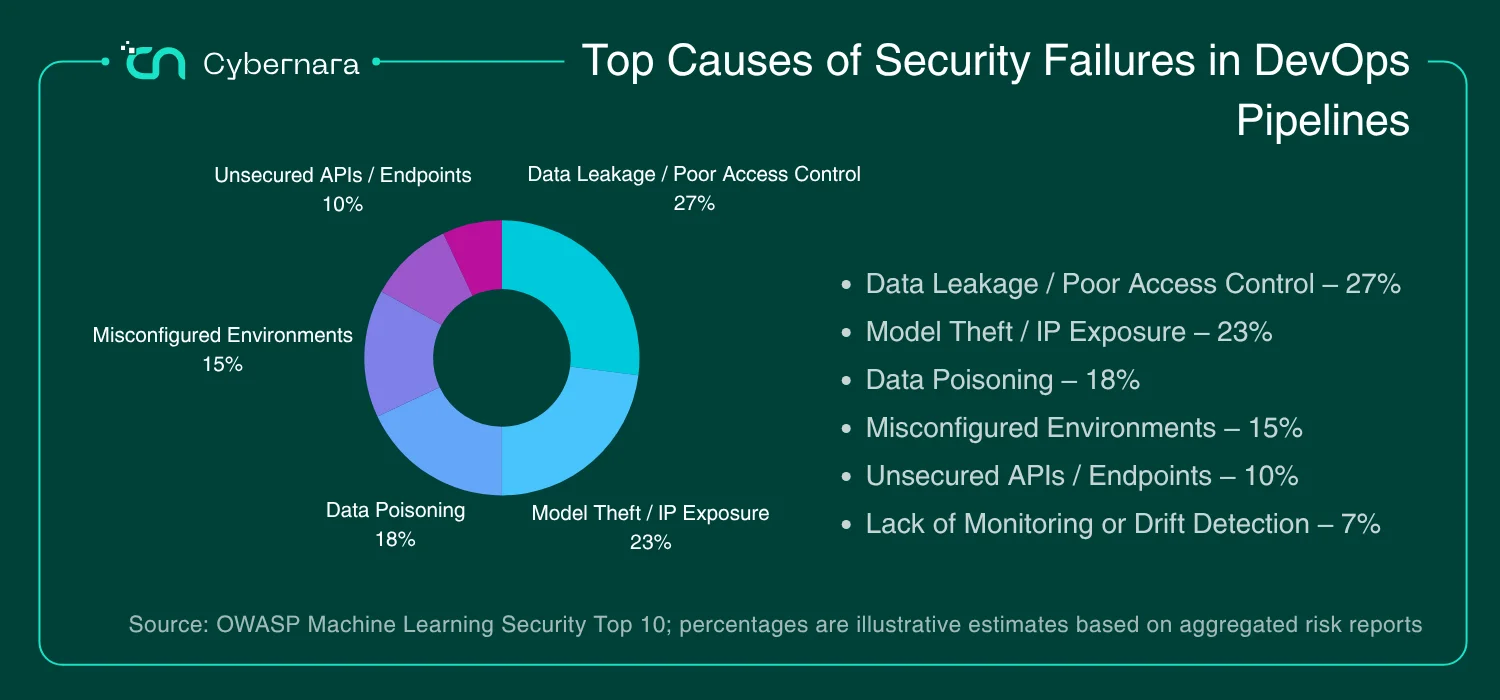
Where Security Usually Breaks in MLOps Pipelines
Machine learning pipelines process massive amounts of sensitive data — yet many fail not because of bad models, but because of security gaps hidden in the workflow itself.
Here are the most common failure points that compromise MLOps environments:
Unverified or Poisoned Data Inputs
Data enters the training pipeline without integrity checks or source validation.
Even a small percentage of tampered samples can bias predictions or inject hidden triggers into models.
Insecure Model and Artifact Storage
Datasets, features, and models often reside in unsecured cloud buckets or local paths.
Without encryption and access control, attackers can alter model weights or steal valuable intellectual property.
Hard-Coded Secrets in Code or Notebooks
API keys, credentials, or tokens embedded in scripts or shared notebooks become instant attack vectors.
A leaked Git commit can expose your entire data infrastructure.
Unprotected Model Endpoints
Deployed models or inference APIs left without authentication or rate limits invite model extraction, prompt injection, or denial-of-service attacks.
Lack of Continuous Monitoring and Drift Detection
Once models are live, many teams stop watching.
Without runtime anomaly detection, abuse monitoring, or drift alerts, issues go unnoticed until performance — or privacy — collapses.
Most MLOps breaches begin with small oversights — unsecured data, weak access, or missing visibility. Secure MLOps turns those weak points into continuous control points, keeping your models trustworthy from data to deployment.
What Does the MLOps Lifecycle Include in India?
Data Collection and Preparation
Model Development and Training
Model Validation and Testing
Deployment and Serving
Monitoring, Governance, and Retraining
A Secure MLOps lifecycle isn’t just about training models faster — it’s about keeping every stage of that lifecycle transparent, traceable, and tamper-proof.
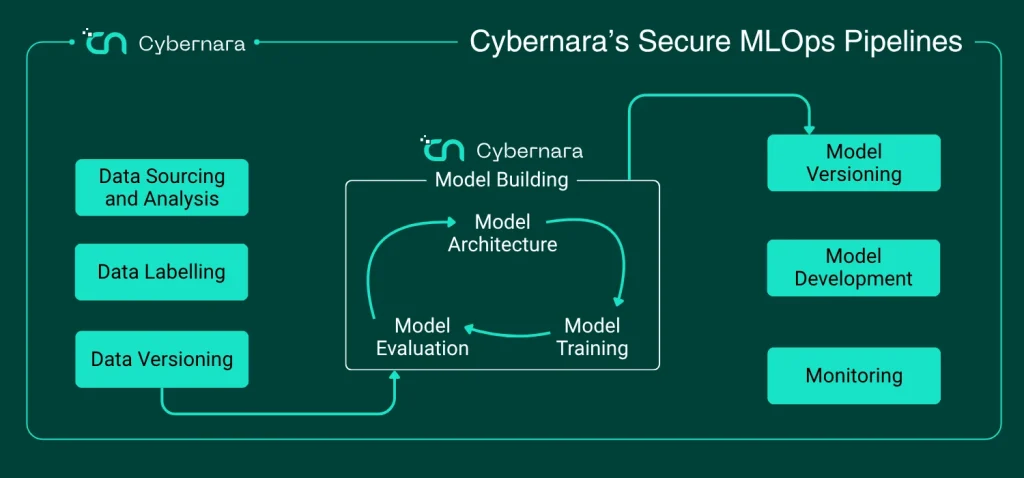
Cybernara’s Secure MLOps Pipelines
Our Secure MLOps framework embeds protection and traceability at every stage — from sourcing and labeling data to training, deploying, and monitoring models. Each step is designed for transparency, reproducibility, and security, ensuring that your AI systems are not only high-performing but also trustworthy by design.
With Cybernara, every model is built, deployed, and governed through a secure, auditable, and continuously monitored pipeline.
Clients Who Trust Us





How We Secure Each Phase of the MLOps Lifecycle
Data Collection and Preparation
Feature Engineering and Versioning
Model Training and Experimentation
Model Validation and Testing
Model Registry and Storage
Deployment and Serving
Benefits of Securing the MLOps Lifecycle Early in India
Adding security after a model is live is like locking the door after a breach.
Embedding protection early in the MLOps lifecycle keeps data, models, and infrastructure resilient from the very beginning — without slowing innovation.
Here’s what early security delivers:
Lower Remediation Costs
Vulnerabilities caught during data preparation or model training cost far less to fix than post-deployment breaches.
A proactive approach prevents re-engineering, downtime, and reputational loss.
Greater Model Integrity and Trust
When datasets are validated and models are versioned securely, every outcome is verifiable.
Stakeholders can trust predictions because the entire lineage — from data source to deployment — is tamper-proof.
Faster and Safer Deployment Cycles
Security automation within CI/CD pipelines eliminates late-stage friction.
Teams release faster while maintaining strong authentication, secrets management, and policy compliance.
Regulatory Compliance by Default
Integrating encryption, audit trails, and explainability frameworks from day one ensures alignment with GDPR, HIPAA, and emerging AI governance norms.
Compliance becomes an outcome, not an obstacle.
Improved Monitoring and Resilience
Early integration enables real-time drift detection, anomaly alerts, and continuous visibility.
Issues are caught before they evolve into operational or ethical failures.
Securing MLOps early means you’re not reacting to risks anymore after they happen — you’re preventing them. It transforms machine learning from a high-speed innovation race into a secure, sustainable, and trustworthy system that scales safely.
Services Our Clients Trust Us With
Protect Your Data, People & Business From Threat Attacks
Get Started With A Free Security Audit
FAQs
Do we need new tools to make our MLOps secure?
Not always.
Most teams can start by integrating security into their existing platforms — like adding encryption, access control, and scanning to tools such as MLflow, Kubeflow, or Vertex AI.
It’s more about hardening what you already use than replacing it.
What’s the biggest risk in unsecured MLOps pipelines?
Data poisoning and model tampering.
If attackers alter training data or steal deployed models, it can compromise predictions and expose sensitive business logic.
How long does it take to implement a Secure MLOps framework?
Typically 3–6 months for integration with existing ML workflows.
Full maturity — including compliance automation and continuous monitoring — can take up to a year depending on complexity and scale.