
Security Health Checks Australia
Top Causes of Security Incidents
The data makes one thing clear — cyber risk rarely comes from the unknown. It comes from what we already know but forget to check. That’s exactly where health checks step in.

What Health Checks Reveal
Security issues rarely shout. They are found through logs, outdated permissions, and dusty configurations left behind by projects that moved too fast.
Health Checks help translate those whispers into action showing what’s quietly changing in your environment while no one’s looking.
Here’s what they often uncover:
Forgotten Access and Ghost Accounts
Accounts of employees who left months ago, test users that never got deleted, or credentials hardcoded into scripts. They sit idle until someone decides to use them.
A health check spots these silent backdoors before someone else does.
Security Controls That Aged Out
What was “best practice” last year might now be deprecated. We often find firewalls that haven’t been updated since migration, encryption algorithms that no longer meet compliance standards, or policies that look strong on paper but don’t work in practice.
A health check brings these silent degradations into focus — long before they turn into incidents.
Tools Working in Silos
Monitoring, identity, and endpoint systems often don’t talk to each other. That means alerts go uncorrelated, and the story of a threat gets scattered across dashboards.
A health check connects these dots to show what your defenses look like in motion, not just in screenshots.
The Human Factor
Misconfigurations don’t happen by themselves — they happen because people take shortcuts under pressure.
Health checks reveal where process fatigue has set in — when rules are ignored because they slow work down, or when exceptions become the norm.
The Illusion of Compliance
Passing an audit doesn’t mean being secure. Many organizations meet the letter of a standard but miss the spirit of security.
A health check highlights this gap — between documented protection and actual resilience.
Patterns We See Repeating For Our Clients in Australia
Temporary Fixes That Become Permanent
Over-trusting Automation
Neglected Monitoring Alerts
Unclear Ownership
Security as a One-Time Project
A health check reminds organizations that security is a living process, not a completed task.
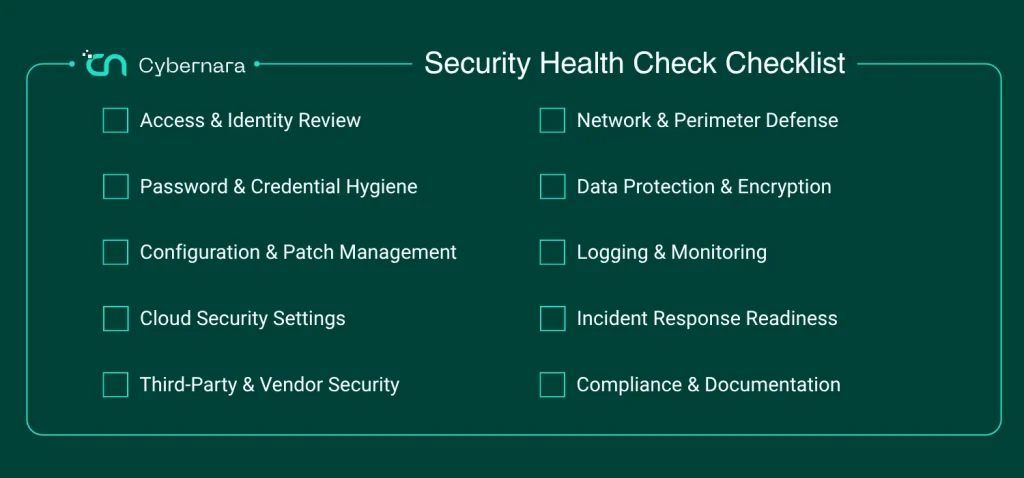
Security Health Check Checklist
This is Cybernara’s starting checklist (not the full assessment), but the foundation of how we begin. Each check opens another layer of discovery, guiding us deeper into configurations, behaviors, and blind spots that routine reviews often miss.
Clients Who Trust Us







Can a Security Health Check Guarantee Fewer Hacks
Eliminating Entry Points Before They’re Found
Keeping Systems Patched and Updated
Strengthening Identity and Access Controls
Detecting Configuration Drift Early
Improving Response Readiness
A Security Health Check can’t promise immunity, but it makes breaches rarer, smaller, and easier to recover from — turning uncertainty into control.
How Security Health Checks Lead to Better Compliance in Australia
Compliance frameworks demand evidence, not assumptions. A Security Health Check ensures your organization doesn’t just tick boxes but actually meets the intent behind every control — protecting both data and reputation.
Keeping Controls Aligned with Standards
Regulations like ISO 27001, GDPR, and SOC 2 evolve regularly. Health checks map your existing configurations and policies against these benchmarks, identifying gaps before auditors do.
Maintaining Audit-Ready Documentation
Most audits fail because evidence is outdated or incomplete. Routine assessments generate up-to-date reports, logs, and validation records that make demonstrating compliance effortless.
Reducing Human Error in Reporting
Manual reporting introduces inconsistencies. Automated and periodic health checks standardize how data is collected and presented, minimizing the risk of omissions or inaccuracies.
Strengthening Data Governance
Compliance isn’t just about controls; it’s about accountability. Regular reviews clarify ownership of data, permissions, and processes — making sure every action is traceable and defensible.
Security Health Checks don’t replace compliance — they reinforce it, translating complex requirements into consistent habits that stand up to scrutiny.
Services Our Clients Trust Us With
Protect Your Data, People & Business From Threat Attacks
Get Started With A Free Security Audit
FAQs
Is a Health Check the same as a penetration test?
No. A penetration test simulates an attack to find vulnerabilities, while a Health Check assesses your entire security posture — people, processes, and technology — to prevent those vulnerabilities from arising.
Does a Health Check replace compliance audits?
It complements them. Compliance audits verify adherence to standards; health checks verify whether those controls still work. Together, they ensure both paperwork and protection stay aligned.
What happens after issues are found?
Findings are categorized by risk level and mapped to actionable recommendations. The goal isn’t to blame — it’s to prioritize, fix, and strengthen before the next check cycle begins.
Who should be involved in the process?
Security and IT teams lead it, but real improvement happens when management, operations, and development teams collaborate. Security works best when it’s everyone’s responsibility.