
Identity & Access Management
Our Identity & Access Management Services Are global and Available In Multiple Countries
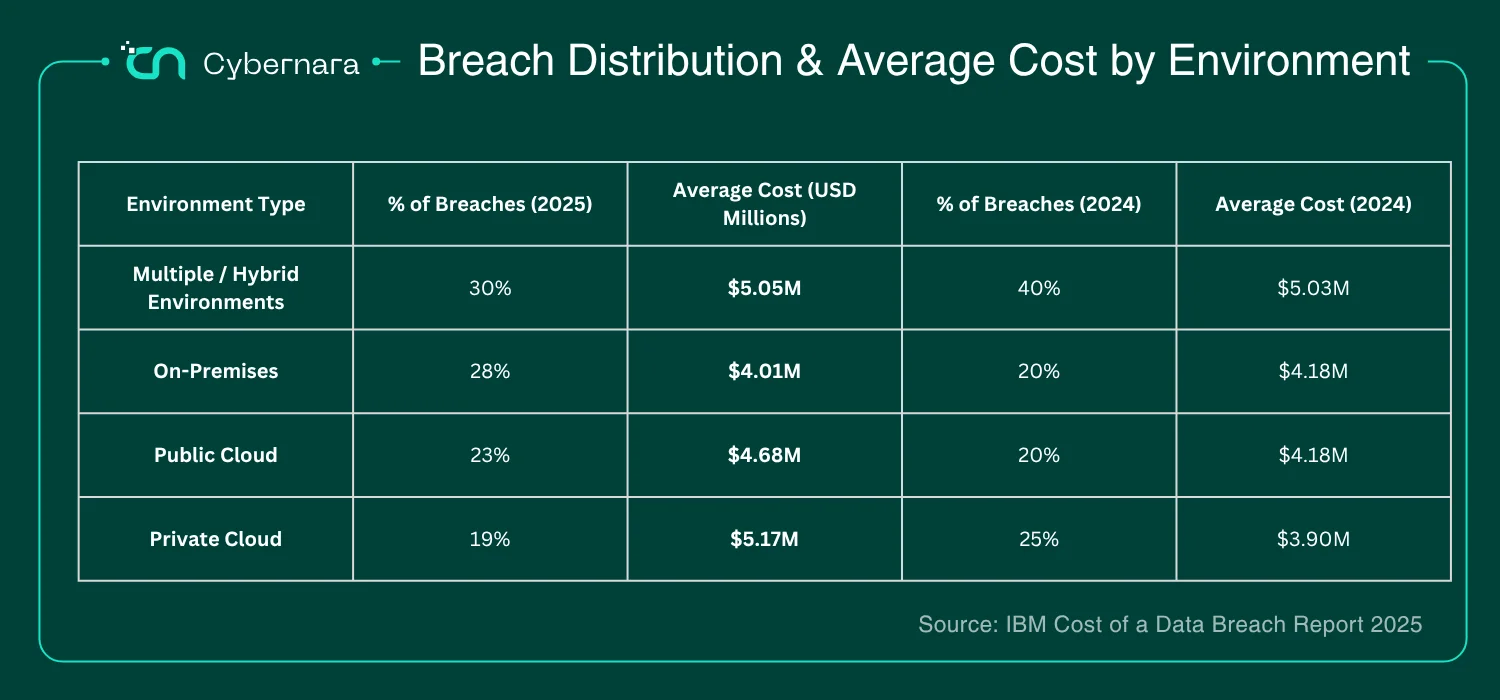
Breach Distribution & Average Cost by Environment
Hybrid and multi-cloud environments remain the most frequent targets, accounting for nearly a third of all breaches. They’re also among the costliest, reflecting the added complexity of managing security across distributed infrastructures.
Where Identity Actually Breaks
Identity doesn’t usually fail because technology is missing — it fails because process and timing do. Passwords get reused, access reviews get skipped, and service accounts live longer than the people who created them.
IAM breakdowns happen quietly until one forgotten account becomes the perfect way in.
Here’s what that looks like in practice:
Shared Credentials That Never Die
Teams under pressure share admin logins “just for now.” Months later, no one remembers who still has them.
Attackers do. One compromised password can give them invisible persistence for months.
Over-Privileged Access
Temporary roles and one-time permissions often become permanent.
What was meant for convenience turns into privilege creep — granting far more power than anyone needs.
Forgotten Service Accounts
Applications and scripts use hardcoded credentials that never expire.
When developers move on, those accounts stay behind, holding silent, unlimited access.
Broken Review Cycles
Quarterly access reviews become annual, then optional.
Without consistent revocation, identity hygiene decays until security teams are managing assumptions instead of facts.
The JML Lifecycle: Joiners, Movers, Leavers
Slow or Manual Provisioning
Movers Who Keep Their Old Keys
Leavers Who Still Have Access
No Audit Trail of Approvals
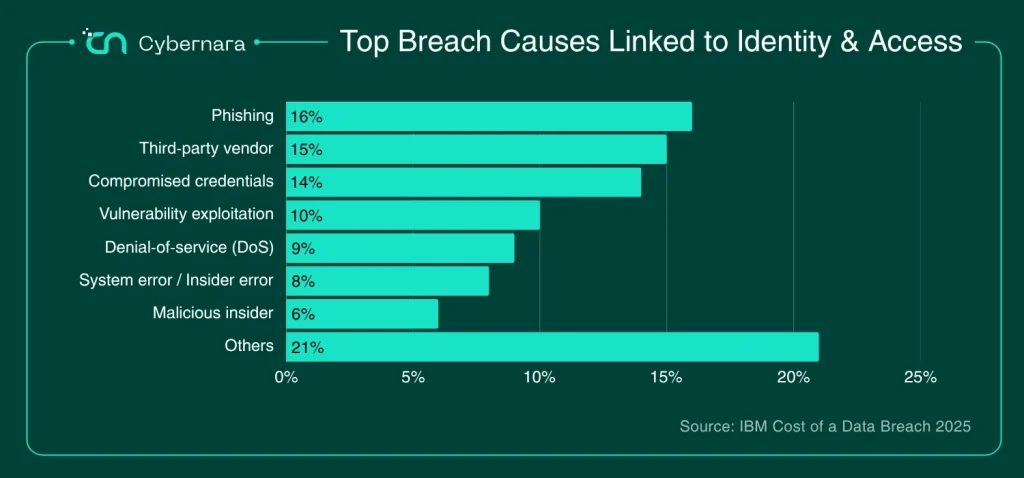
Top Breach Causes Linked to Identity & Access
Phishing, compromised credentials, and third-party access together account for nearly 45 % of all incidents: each one rooted in trust misuse or weak authentication. It proves that strengthening identity controls isn’t optional. It’s the most direct path to shrinking the global breach surface.
Clients Who Trust Us







Compliance Through Identity
Every Access Change Is Traceable
Policies That Enforce Themselves
Separation of Duties by Design
Evidence Without the Panic
How Cybernara Designs IAM That Companies Actually Use
Security isn’t effective when users try to bypass it. Cybernara builds IAM systems that work with people, not against them — enforcing strong controls without breaking productivity.
Here’s how our design philosophy translates into daily use:
Access Workflows That Feel Natural
Requests, approvals, and reviews happen where teams already work — in Slack, email, or their ticketing tools.
No one needs to learn a new system just to do the right thing.
Automation That Reduces Fatigue
Repetitive tasks like provisioning and de-provisioning are handled by automation with clear audit logs.
Security teams focus on oversight, not firefighting.
Adaptive Authentication
MFA and conditional access respond to behavior and context.
Users logging in from trusted devices get speed; unusual logins get extra scrutiny.
Built-In Adoption and Change Management
Every rollout includes user training, communication plans, and feedback loops.
When employees understand why IAM changes exist, compliance becomes voluntary, not forced.
Services Our Clients Trust Us With
Protect Your Data, People & Business From Threat Attacks
Get Started With A Free Security Audit
FAQs
Isn’t Single Sign-On (SSO) the same as IAM?
No. SSO is one part of IAM — it simplifies user access.
IAM is the broader system that governs who gets access, when, how, and under what conditions across all applications, systems, and APIs.
How often should access reviews be performed?
At least quarterly and automatically if possible.
Modern IAM tools can trigger periodic certifications, ensuring that access rights stay current and unused permissions are removed without manual effort.
Does implementing IAM slow down user productivity?
Not when it’s designed well.
Cybernara’s IAM approach integrates directly into existing workflows, making secure access faster, not harder.
When users understand why controls exist, they stop bypassing them.