
Virtual CISO (vCISO) UAE
Why Security Leadership Is Missing In Most UAE Companies
Security gaps in fast-growing companies rarely come from neglect — they come from pace. As teams scale, tools multiply, and priorities shift, security leadership slowly slips into the background. Not because nobody cares, but because growth outruns governance.
These are the real reasons leadership disappears even in well-intentioned organizations.
Security Decisions Are Scattered Across Teams
Developers, IT, product, and operations all make security-impacting choices — but no one connects these decisions into a single strategy, so risks spread silently.
CTOs Are Already Overloaded
Engineering leaders are expected to “handle security,” but product deadlines, outages, and hiring always take priority, leaving security as a part-time task.
Tools Grow Faster Than Expertise
Companies adopt firewalls, EDR, SSO, and cloud platforms quickly — but without someone guiding standards and configuration, tools become noisy or misaligned.
Compliance Pressure Arrives Suddenly
SOC 2, ISO, or privacy requirements appear with customer or regulator demands — and without leadership, companies scramble reactively instead of preparing early.
Everyone Assumes Someone Else Owns It
IT thinks engineering handles security, engineering thinks IT does, and leadership assumes both are aligned — leaving critical responsibilities unclaimed.
Virtual CISO vs Full-Time CISO vs External Consultant
The Full-Time CISO Who Lives Inside the Business
The External Consultant Who Solves the Problem and Moves On
The Virtual CISO Who Leads Without Needing a Full-Time Seat
The Real Difference: Who Stays Responsible Over Time
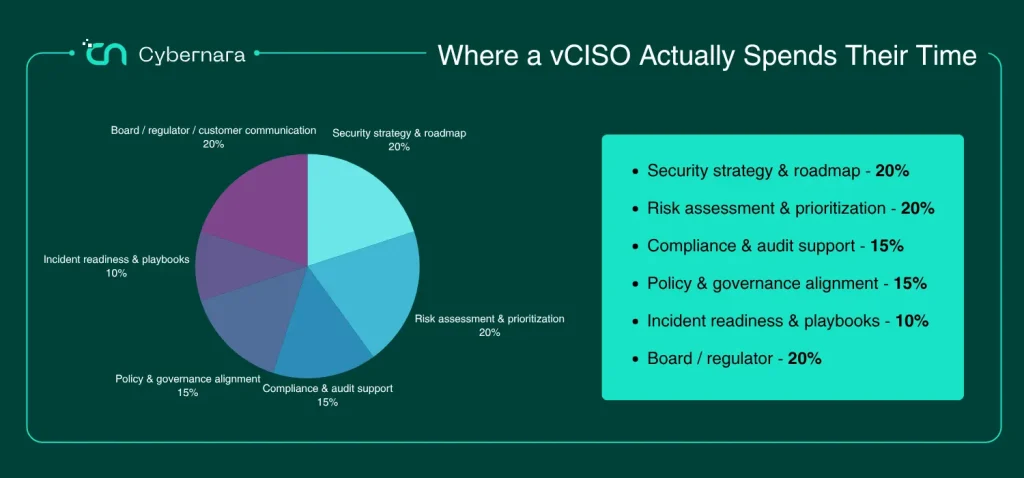
Where a vCISO Actually Spends Their Time
A vCISO’s time is spread across the entire security lifecycle. The work moves between strategy, risk, compliance, incident readiness, and communication with boards, auditors, and customers. This distribution shows why a vCISO is not a consultant or a technician, but a security leader who keeps every part of the program moving in the right direction.
Clients Who Trust Us







Board, Regulators, and Customers: Who Your vCISO Speaks For You
Speaking to the Board: Clarity Without Complexity
Managing Regulators: Compliance Translated Into Evidence
Handling Customer Security Reviews: Confidence, Not Anxiety
Interfacing With Cyber Insurers: Keeping Premiums Under Control
Supporting Internal Leadership: Turning Unknowns Into Priorities
Representing You During Incidents: Calm, Structured Communication
When a Virtual CISO Is the Right Answer — and When It Isn’t In UAE
Not every organization needs a full-time CISO, and not every organization can rely solely on consultants. The right choice depends on scale, pace, and the kind of pressure your business faces.
A Virtual CISO fits beautifully in certain environments and falls short in others. Knowing the difference is what makes the decision strategic instead of reactive.
A vCISO Works Best for Growing Teams That Need Leadership, Not Headcount
Fast-growing companies often have security challenges that outpace their internal experience. They don’t need a full-time executive, but they do need someone senior to set direction, manage risk, and speak for them in high-stakes conversations. A vCISO brings mature leadership without adding permanent payroll burden.
Mid-Market Organizations Where Security Is Critical but Not Constant
These companies handle sensitive data and face customer expectations, but security issues don’t surface every hour of every day. A flexible executive presence is enough to guide strategy, run reviews, and maintain readiness. A vCISO fits the rhythm of their work without overwhelming their budget.
Regulated SaaS and Cloud-First Startups Under Continuous Scrutiny
SaaS companies selling to enterprises face nonstop demands — security questionnaires, audits, vendor reviews, and architecture evaluations. They need a leader who can represent them credibly and maintain compliance momentum. A vCISO gives them that leadership without slowing agility.
A Virtual CISO is the perfect fit when you need real leadership without the cost, hiring effort, or permanence of a full-time executive. But when your scale, risk, or complexity demands someone embedded every day, an in-house CISO is the only honest answer.
Services Our Clients Trust Us With
Protect Your Data, People & Business From Threat Attacks
Get Started With A Free Security Audit
FAQs
How many hours does a Virtual CISO typically work each month?
Most vCISO engagements range from 20–40 hours per month, depending on your size, compliance needs, and project load. The goal is to give you senior leadership without the cost of a full-time executive.
Can a vCISO replace a full-time CISO?
For growing companies, yes — a vCISO provides the same strategic direction, governance, and oversight. For large or heavily regulated enterprises, a full-time, embedded CISO is usually required.
Can a vCISO help us prepare for SOC 2 or ISO 27001?
Absolutely. vCISOs guide the entire journey: gap assessment, control selection, policy alignment, evidence preparation, and audit readiness.
Is a vCISO only for SaaS companies?
No. vCISOs support SMBs, mid-market firms, service providers, manufacturers, healthcare companies, and any org that needs experienced security leadership.