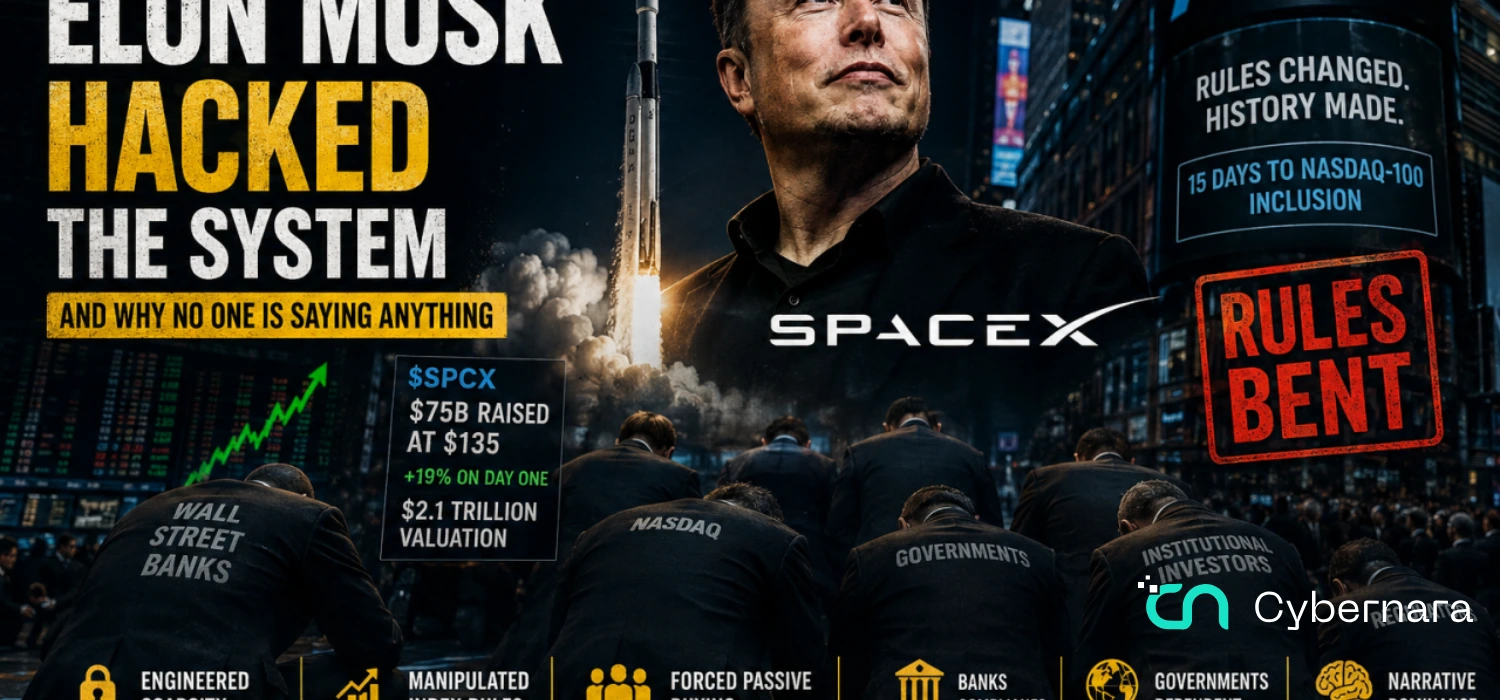
Imagine one person owning the airport, the airline, the fuel supply, the control tower… and then asking everyone to applaud when his plane takes off first.That’s what the SpaceX IPO felt like.
Yes, it was historic.
$75 billion raised. $SPCX up 19% on day one. A valuation above $2 trillion. Elon Musk entering trillionaire territory.
But behind the celebration is a much darker question:
Did SpaceX just prove innovation wins?
Or did Elon Musk prove that if you become powerful enough, the market bends around you?
The IPO Wasn’t “Demand.” It Was Designed Scarcity.
SpaceX floated only a tiny slice of the company.
That means there were not enough shares for the amount of institutional demand chasing the deal.So the price popped.
Simple.
But let’s not pretend this was organic price discovery.
This was supply restriction dressed up as market excitement.
When you intentionally release limited supply into massive demand, you are not “discovering” value.
You are manufacturing pressure.
It is the same logic as sneaker drops, concert tickets, and iPhone launch queues.
Except this time, the product was a $2 trillion company.
The Banks Didn’t Advise. They Surrendered.
Normally, investment banks are supposed to bring discipline to an IPO.
They question valuation. They test demand. They protect market credibility.
But with SpaceX, the banks looked less like gatekeepers and more like passengers.
Because no bank wanted to be the one left off the biggest IPO in history.
So instead of asking, “Is this valuation reasonable?”
The system asked, “How do we make sure we get a seat?”
That is not healthy market behavior.
That is dependency.
Nasdaq Didn’t Just Win the IPO. It Changed the Rulebook.
This is where the story gets wild.
For years, the Nasdaq-100 had a basic expectation:
A company had to prove itself in the public market first.
No instant VIP entry. No red carpet on day one. No “welcome to the index because you’re famous.”
Newly listed companies typically had to wait for the annual reconstitution and meet a seasoning period before joining the Nasdaq-100. But just before the SpaceX IPO, Nasdaq rolled out a new “Fast Entry” rule allowing certain mega-cap newcomers to enter the Nasdaq-100 after just 15 trading days if they ranked among the top 40 by market cap.
Convenient?
That word is doing a lot of cardio.
Because Reuters reported that SpaceX wanted early Nasdaq-100 inclusion as a condition for potentially listing on Nasdaq — while the NYSE was also competing for the deal. Nasdaq’s rule change was specifically described as a way to attract mega-cap IPOs like SpaceX, Anthropic, and OpenAI.
Translation:
Nasdaq didn’t just say, “Please list with us.”
Nasdaq said:
“Tell us what the runway needs to look like, and we’ll repave it before takeoff.”
And it worked.
Reuters later reported that SpaceX picked Nasdaq, calling it a major victory over the New York Stock Exchange — especially because this was expected to be one of the biggest market debuts ever.
This is the part people should not miss.
Nasdaq was not competing for another listing.
It was competing for the IPO of the decade.
Maybe the IPO of the century.
And to win it, Nasdaq effectively gave SpaceX something NYSE could not match:
A faster path into the Nasdaq-100. A faster path into passive funds. A faster path into the portfolios of millions of investors who may not even realize they are buying SpaceX.
Because once a company enters a major index, passive funds do not sit around asking, “Is this valuation reasonable?”
They buy because the benchmark tells them to buy.
That is the machine.
And Musk understood the machine better than the machine understood itself.
He didn’t just make banks compete.
He made exchanges compete.
He didn’t just raise capital.
He made Nasdaq adjust its decades-old market plumbing so SpaceX could launch with maximum financial thrust.
That is not an IPO.
That is market gravity being rewritten in real time.
The Dangerous Precedent
This IPO sends a message:
Become big enough. Become strategic enough. Become culturally dominant enough.
And the rules will stretch.
Banks will rationalize. Exchanges will adapt. Governments will hesitate. Investors will chase.
That may be good for Musk.
It may even be good for SpaceX.
But is it good for public markets?
That is a very different question.
Because public markets depend on trust.
Trust that price discovery is real. Trust that rules are neutral. Trust that access is fair. Trust that hype does not overpower accountability.
The SpaceX IPO challenges all of that.
TL;DR
The SpaceX IPO was historic.
But history is not always healthy.
Tiny float. Massive hype. Index mechanics. Bank FOMO. Government dependence. Narrative dominance.
This was not just a company going public.
It was a stress test of whether modern markets can say “no” to someone as powerful as Elon Musk.
And the answer looked uncomfortably clear:
They cannot.
So the real question is not whether SpaceX is a great company.
It probably is.
The question is whether any founder should have enough gravity to bend banks, exchanges, governments, and investors into orbit around him.
Because when the market becomes one man’s launchpad…
Everyone else is just standing under the rocket.